The shadow side
Lilith and Selena: the Black Moon and the White Moon
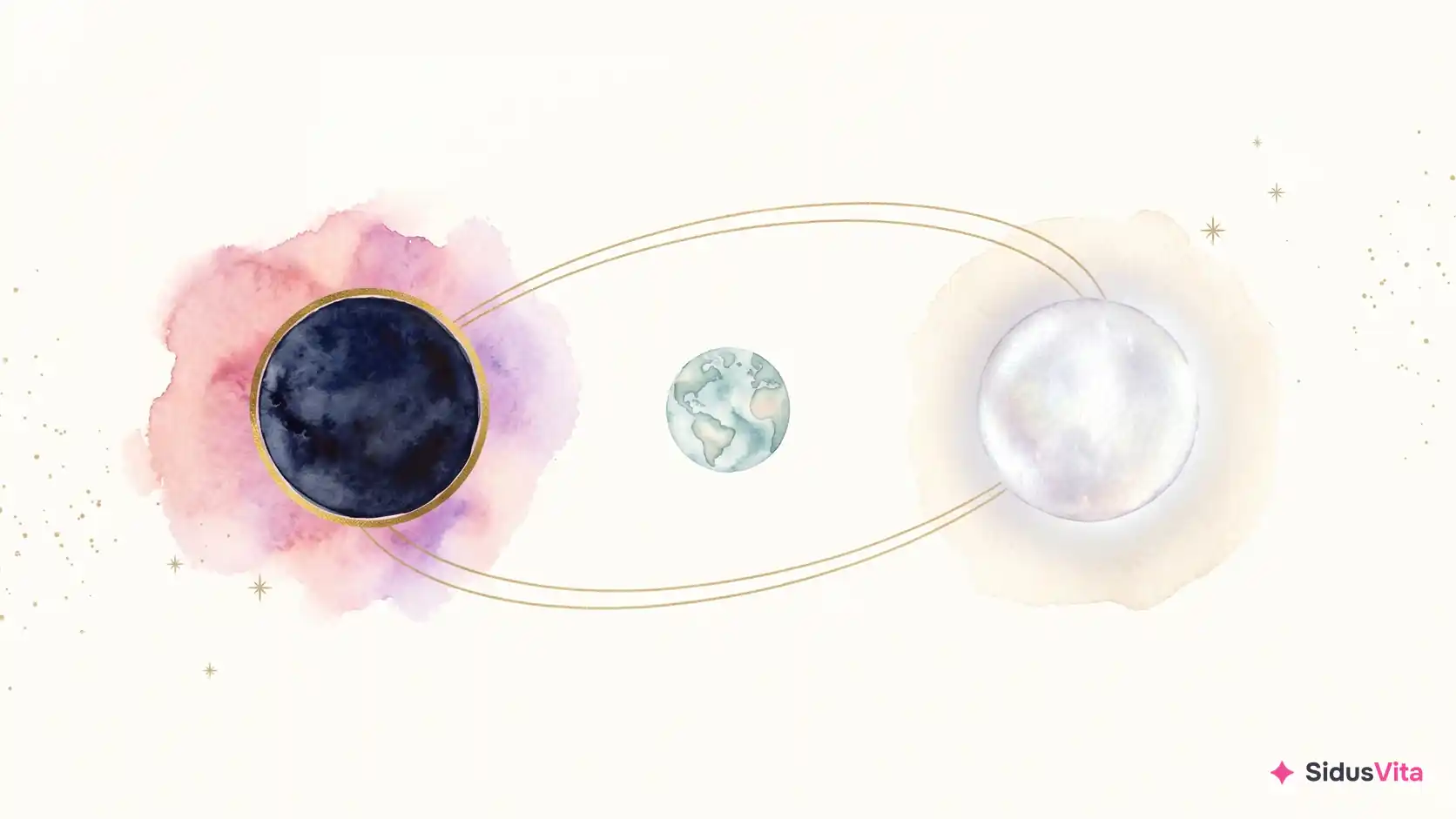
Black Moon Lilith and White Moon Selena often appear as a pair in search queries, yet they come from different calculations and have very different levels of agreement among astrologers. In modern astrology, Black Moon Lilith is the lunar apogee, the point on the Moon’s orbit farthest from Earth. Mean Lilith completes a full circle through the zodiac in 8 years and 10 months, and because astrologers use two versions of the calculation, mean and true, about a third of all people have their two Liliths in different signs. White Moon Selena was introduced into Russian-language astrology by Pavel Globa’s school of Avestan astrology. In that school Selena is a hypothetical point with a seven-year cycle, while some astrologers give the name White Moon to the lunar perigee, the point closest to Earth. Because there is no single calculation method for Selena, the SidusVita calculator computes only Lilith.
Two Points on the Moon’s Orbit and a Hypothetical Cycle
When people look up Lilith and Selena in a natal chart, the pairing sounds like a neat symmetry of dark and light. On the astronomical side of chart drawing, only one half of this pair has a settled definition.
In modern astrology, Black Moon Lilith is the apogee of the lunar orbit, the point where the Moon is farthest from Earth. The opposite end of that same elliptical path is the perigee, which is the point of the lunar orbit closest to Earth.
For Lilith, the astronomical foundation is shared across contemporary practice, even though two mathematical ways of plotting the apogee exist. Those two versions are called mean Lilith and true Lilith. Mean Lilith moves smoothly and completes a full circle in 8 years and 10 months. Because the Moon’s orbit wobbles, the true apogee shifts back and forth around the mean position, and for roughly one third of people, mean Lilith and true Lilith land in different zodiac signs.
For the White Moon, the situation is different. There is no single method for calculating Selena. Some astrologers use the name White Moon for the lunar perigee, pairing it directly with the apogee on the Moon’s physical orbit. Other astrologers treat Selena as a separate point altogether, unconnected to the perigee.
How Selena Entered Russian-Language Astrology
The concept of Selena, or the White Moon, was introduced into Russian-language astrology by the school of Pavel Globa, known as Avestan astrology. According to the encyclopedia Cyclowiki, “Pavel Globa claims that Selena personifies the bright, good principle in a person”).
Within the Avestan tradition, the Black Moon is placed as the counterpart to this principle and is given a specific name. According to the Globa Institute, as reported by Azattyq on October 20, 2023, in the Avestan tradition the Black Moon is called Druj, which translates as “Lie”.
In this school’s framework, Selena is a separate point with a seven-year cycle, distinct from the lunar perigee. Because the Avestan system became widely read in Russian-speaking countries, the pairing of Black Moon and White Moon turned into a familiar fixture of popular chart readings, even though the two points are built on different premises.
Selena’s Seven-Year Cycle
In Pavel Globa’s school, Selena is a separate hypothetical point with a seven-year cycle, not tied directly to the Moon’s orbit. Some other astrologers use the name White Moon for the lunar perigee instead. So the same name can mean two different points, and a chart table that shows Selena without naming its method does not tell you which one was calculated.
The two Moons side by side:
| Black Moon (Lilith) | White Moon (Selena) | |
|---|---|---|
| What it is | the apogee of the lunar orbit, its farthest point from Earth | in Pavel Globa’s school, a hypothetical point with a seven-year cycle; some astrologers use the name for the perigee |
| Full cycle | 8 years and 10 months (mean Lilith) | seven years (Globa’s school) |
| Method of calculation | two accepted versions, mean and true | no single method |
| In the SidusVita calculator | calculated, both versions | not calculated |
Why People Search for Lilith and Selena Together
In search engines, readers regularly look for phrases such as “lilith and selena in the natal chart”, “lilith and selena in the same house”, “lilith square selena”, and “calculate lilith and selena online”. Each of these queries assumes that both points can be plotted on the same wheel with the same certainty.
Consider what happens when someone searches for “lilith and selena in the same house” or “lilith square selena”. A house placement or an aspect like a square depends on exact degrees along the zodiac circle.
Even when looking at Lilith alone, the degree and sign depend on whether you look at the mean or the true calculation, since a third of all charts have mean Lilith and true Lilith in different signs. When you bring Selena into the same question, the variables multiply.
If a calculation defines the White Moon as the lunar perigee, it will sit on the Moon’s orbit opposite the apogee. If a calculation follows the Globa school and treats Selena as a separate hypothetical point with a seven-year cycle, it will move at a different speed from mean Lilith’s circle of 8 years and 10 months and will land in a completely different part of the chart.
As a result, two people using different tools to “calculate lilith and selena online” can look at the same birth date and time and receive incompatible answers about whether Lilith and Selena share a house or form a square. Without a single method for calculating Selena, an aspect between the two points changes depending on which definition a program happens to use.
How to Read the Pair Without Confusion
Astrology works best as a clear language of interpretation when you know how each symbol on the page was found. Mixing an orbital point with an unstandardized point often leaves readers puzzling over conflicting chart printouts.
When you come across mentions of the White Moon, the first step is simply to ask which definition is being used. In Russian-language astrology influenced by Pavel Globa’s school, Selena is the seven-year hypothetical point that, as Cyclowiki notes, “personifies the bright, good principle in a person”, paired against the Black Moon, which the Avestan tradition calls Druj — “Lie”. In other contexts, the phrase White Moon refers to the lunar perigee, the point on the Moon’s orbit closest to Earth.
For Black Moon Lilith, the footing is clear. It is the lunar apogee, moving through its full mean cycle in 8 years and 10 months, with both its mean and true positions available to examine side by side. Looking at both versions of Lilith shows you whether you are among the two thirds of people whose mean and true Lilith share a sign, or among the one third whose two versions fall in different signs.
Why SidusVita Calculates Lilith and Leaves Out Selena
When we built the SidusVita calculator, we had to decide how to handle requests from readers who want to calculate Lilith and Selena online in one place. We chose an honest approach: our calculator computes Black Moon Lilith in full detail and does not calculate Selena, because there is no single method for calculating Selena.
Rather than picking one version of the White Moon — either the seven-year hypothetical point from the Globa school or the lunar perigee used by some astrologers — and presenting it as the single standard, we focus on the point that rests on a defined astronomical element of the lunar orbit.
For Black Moon Lilith, the SidusVita calculator gives you both versions, mean and true, so you can see right away if yours sit in the same sign or belong to the third of charts where they divide into two signs. It also calculates Lilith’s sign, house placement, aspects, and the specific “face” of Lilith in your chart. If you want to explore how the lunar apogee works in your own birth data, you can calculate Lilith on our page and read a breakdown of both its mean and true positions.