Synastry
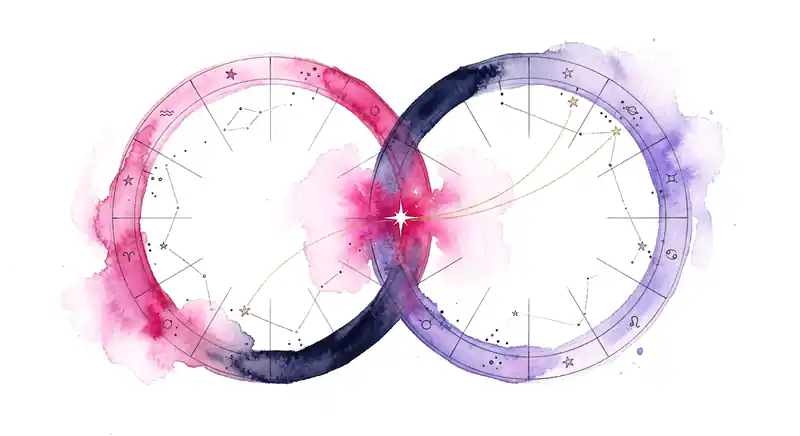
Two charts, laid side by side
Synastry doesn't read you, and it doesn't read them. It reads what happens between: where it pulls, where it sparks, and what actually holds it together.
Live example
This is what you get
A real reading of a demo couple — a live panel, not a picture: scroll it, tap any term, switch the school. Watch the same two people read three different ways.
Partial Ashtakuta: 7 of 8 classical factors, scored on the current 35-point scale. Plus the couple archetype, a dasha timeline, and a North Indian chart.
Demo couple · real reading
What the text version of the sample shows
The reading first states the couple's shared storyline, then shows which connections between the two charts produced it.
- Bond archetype
- A concise overview of what draws two people together, what holds the bond, and where recurring tension appears.
- Compatibility axes
- Separate views of communication, attraction, stability, friction, growth, and coordination, with an explanation for each axis rather than one total score.
- Periods and current chapter
- Jyotish mode compares both people's dasha periods, while western mode describes the pair's transit context.
- Chart evidence
- Conclusions are tied to cross-chart aspects, conjunctions, and Vedic compatibility factors, distinguishing a calculation from generic prose.
After loading, the interactive panel shows the same format for a fictional demo couple and lets you switch schools.
Three schools
Three schools, three instruments
Not three tiers of quality — three different ways of looking at the same couple, and each one sees what the others cannot. Switch the chips above the preview and watch it happen.
Jyotish
The Vedic school, with its own maths and its own chart.
Only here
SidusVita currently calculates 7 of the 8 classical Ashtakuta factors. The working score is shown out of 35; the full classical system totals 36 points, with Varna not yet included. You also get the couple's archetype, a dasha timeline, and a North Indian chart.
How this was calculated →Western
Classical aspect geometry on a tropical chart.
Only here
The transit-driven "current chapter" — what is happening between you right now. Plus Venus–Mars and midpoints.
Hybrid
The same western chart, with the lunar nodes added.
Only here
The karmic Rahu–Ketu axis: where the bond pulls you, and what it collects in return. Two points are enough to add noticeably more aspects.
Formats
Not only about love
The same two charts — a different question asked of them, and a different reading out.
Romance
Attraction, each other's emotional language, the places it grinds. What holds you together, and what you keep tripping over.
Friendship
How you talk, what you share, why this person feels like your own. And where that ease runs out.
Work
Responsibility, pace, business communication. Whether you'll actually deliver together when money and deadlines are on the line.
You & your child
How your bond with the child actually works: how to talk to them, what feeds them, where daily life sparks — from two charts, no diagnoses or labels.
You & your parent
The same reading from your side: how to talk to your mother or father, how they show care, where the old roles switch on, and how to hold boundaries without guilt.
Price
Synastry unlocks on Plus
The free tier doesn't have it at all — and we won't pretend otherwise. Synastry computes two full charts and every link between them; it isn't a slice we can break off and hand out for nothing.
Forecasts and natal charts draw on the same pool, so 50 is a ceiling, not a synastry quota.
Pro ($10): a base pool of 200, plus the deeper Deep Pro reading.
Synastry: common questions
What is synastry?
Synastry is a comparison of two natal charts. One person's planets are laid over the other's chart, and the links between them show where the pull is, where the friction is, and what actually holds the relationship together. It is not a sun-sign horoscope: both full charts are calculated from date, time and place of birth.
What do I need to calculate a synastry?
Date, time and city of birth for both people. You have usually built your own chart already; for the partner, enter their details in the form. The engine calculates both charts and every link between them, and the reading is ready in a couple of minutes.
What if I don't know my partner's birth time?
Tick "I don't know the exact time". The partner's chart is built without the ascendant and houses, while the links between planets by sign and aspect remain. Conclusions that depend on houses will be less precise, and the reading says so in the text itself.
How do Western, Hybrid and Jyotish synastry differ?
Western reads aspects between planets on the tropical chart and adds a transit layer for what is happening right now. Hybrid is the same chart with the lunar nodes Rahu and Ketu. Jyotish is the Vedic school with its own chart and kuta system: SidusVita calculates 7 of the 8 classical kutas on a scale of up to 35 points. All three sit in one reading and switch with the chips above it.
Is synastry only about love?
No. The same two charts are read under a different question: romance, friendship, work, or the bond between a parent and a child, in either direction. You choose the format before the calculation, and the reading changes with it: pace and responsibility for a work pair, how to talk and what feeds the child for a parent and child.
How much does synastry cost, and is there a free version?
Synastry unlocks on the Plus plan and costs one request from the base pool. There is no free synastry: it needs two full charts, and we will not pretend that can be given away. Your own natal chart, though, is free and needs no sign-up.
Updated
Now build your own
Two birth dates — yours and theirs. The engine does the rest.
There is no free synastry — it needs two charts. But your own chart is free, and you can build it right now.
The pair calculation itself — both charts' placements and the contacts between them with orbs — is free and needs no account. Free pair calculation →