Charts and practical examples
Mercury Square Jupiter in the Birth Chart: Jackie Chan, John Travolta, Viktor Tsoi and the 13 Days of June 1962

In 1998 Rush Hour made Jackie Chan a Hollywood star, yet nine years later he wrote that he "felt very disappointed" when filming ended: the action felt "too Americanized," and he didn't understand the American humor. His co-star Chris Tucker turned down the sequel to Friday partly because "I don't wanna represent everybody smoking weed." Both men were born with Mercury and Jupiter at odds, an exact square or opposition between the two planets, within one degree, which about 1 person in 68 has. Only 25 of the 3,436 famous people in our "What's rare in your chart" chapter have it, among them John Travolta, Robert Duvall, Pablo Picasso, Olivia Rodrigo and the Russian rock star Viktor Tsoi. We counted every such window from 1880 to 2030: the trait usually lasts about a day and a half, so for most people only a birth time can show it. Then we gathered moments when they argued for what they believed, from interviews and archives linked at the end.
Why so few people have it
Seen from Earth, Mercury never strays far from the Sun: in all the years we checked it got no more than 27.8° away. So it can only stand at a right angle to Jupiter when Jupiter itself is 62° to 118° from the Sun, and it can only stand opposite Jupiter when Jupiter is almost opposite the Sun. That happens three or four times a year, and each time the angle stays within a degree of 90° or 180° for about a day and a half before Mercury moves on. Between 1880 and 2030 there are 512 such windows, and together they cover 1.51% of the time. Our chapter's table of 100,000 charts for people born from 1960 to 2008 gives almost the same share, 1.47%. Squares are nearly three times as common as oppositions, 1,085 charts against 385 in the table.
Five days in February 1954
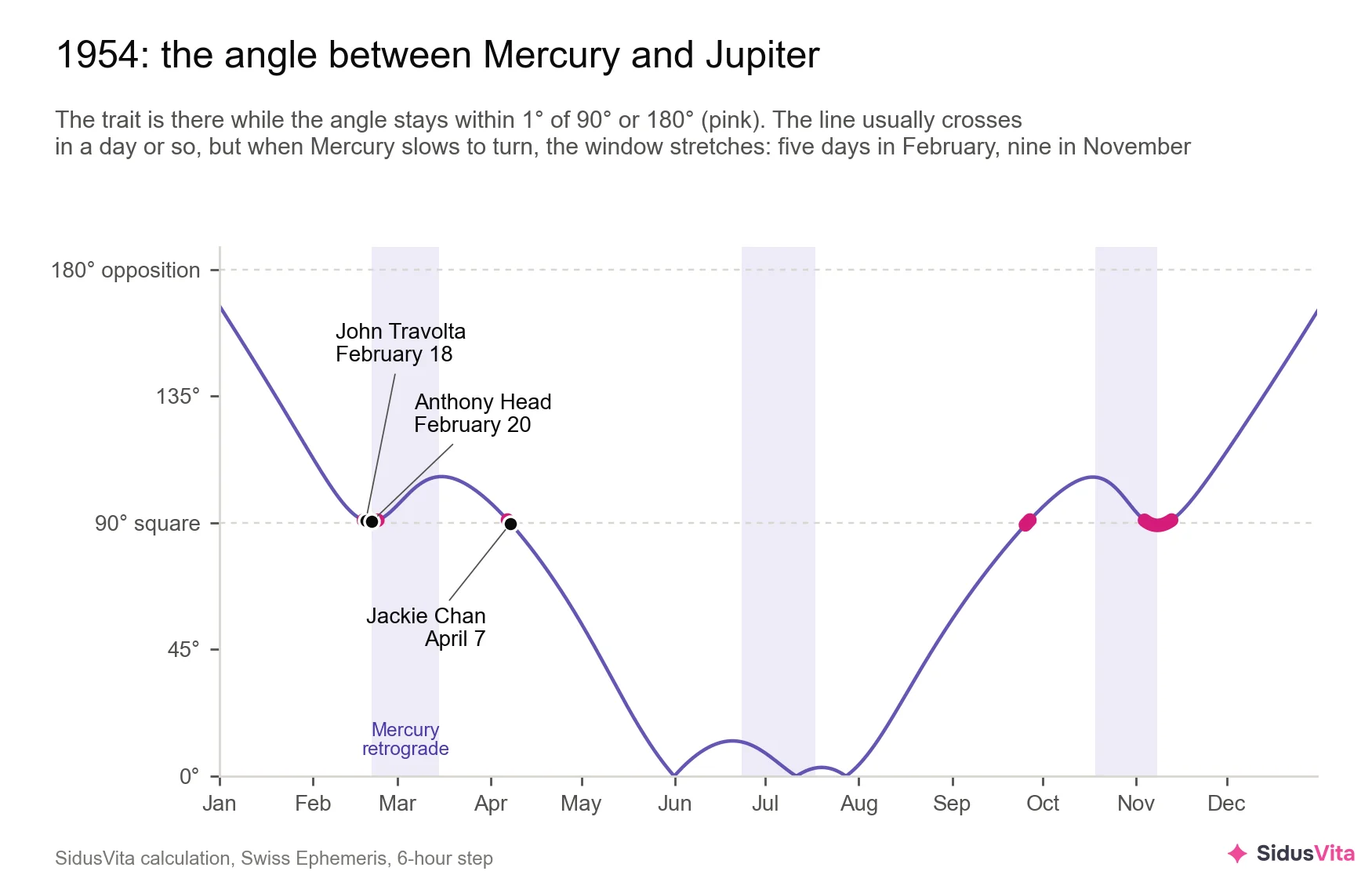
The window gets longer when Mercury slows down to turn around, because the angle then hovers near the mark instead of sweeping past it. In February 1954 Mercury stood still on the 20th before turning retrograde, and the square held from February 17 to 22. John Travolta was born on the 18th, and Anthony Head, Giles in Buffy the Vampire Slayer, on the 20th, the very day Mercury stopped. Jackie Chan arrived on April 7 of the same year, in a window that lasted 41 hours.
The second-longest window in our 150 years opened on June 13, 1962 and closed almost 13 days later, on June 26. Halfway through, on June 19, Mercury stood still before going forward again, and Paula Abdul was born that day in California, with Viktor Tsoi following two days later in Leningrad. Only one window was longer: in August 1912 the square held for 322 hours, about thirteen and a half days.
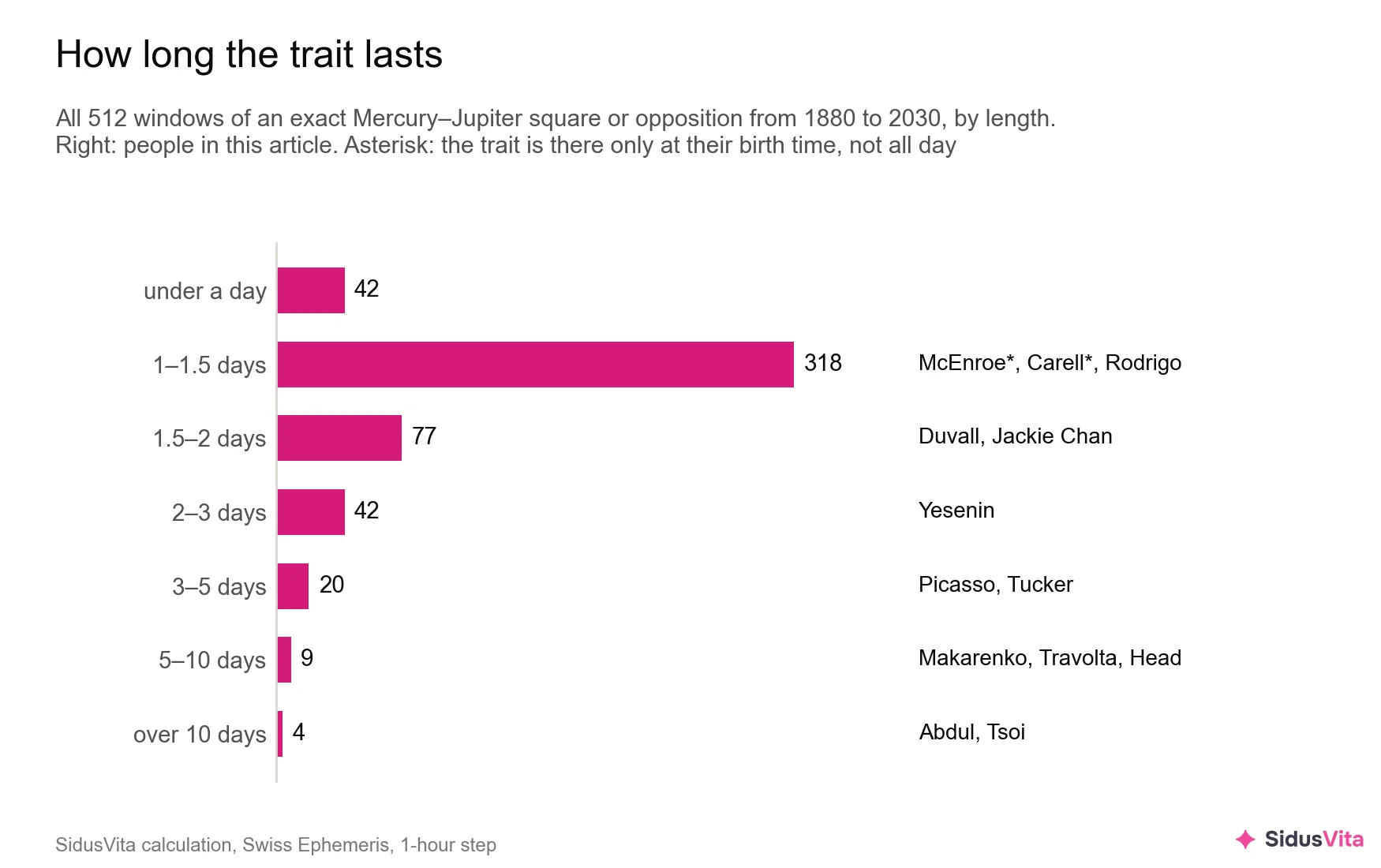
Seven windows in ten are shorter than a day and a half, and only 33 of the 512 last three days or more. Because a short window often covers only part of a birthday, the trait held for a full day on just 0.62% of days between 1960 and 2008, and for part of the day on 1.76%. If you were born on one of those partial days, you have the trait only if you arrived at the right hour.
What astrology reads into it
In astrology Mercury stands for thinking and speech and Jupiter for beliefs and big ideas, and the square and the opposition are the two angles traditionally read as tension. Our chapter calls the trait "Arguing about what matters": "You argue hotly about what you believe, and in the heat of it you jump easily from facts to convictions. You promise more in words than you later have time to do, and people remind you of it." It also offers one piece of advice: "Your view weighs more when you separate 'I know' from 'I believe'."
The promises are hard to check from the outside, and we're leaving private lives alone. Arguments are another matter, since people tend to have them on the record.
Arguing out loud
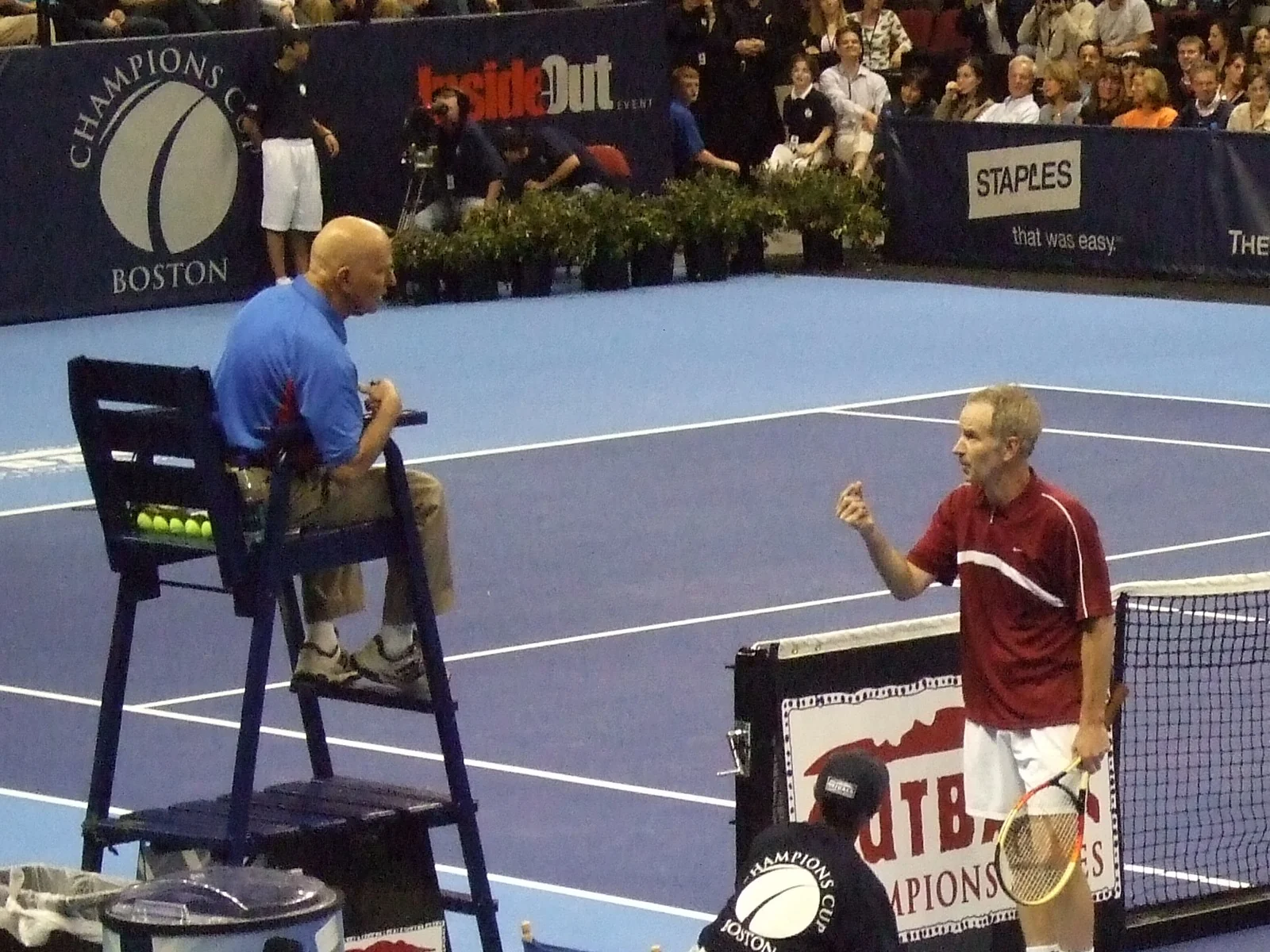
On June 22, 1981, in the first round at Wimbledon, one of John McEnroe's shots was called out, and he walked over to the umpire, Edward James. "You cannot be serious," McEnroe screamed, according to Reuters. "That ball was on the line." The New York Post quoted him the same day: "Why can't I argue -- is it against the law to argue?" Two weeks later he beat Björn Borg in the final, and in 2002 he called his memoir You Cannot Be Serious. McEnroe is one of two exceptions in this article: his trait doesn't last all day and shows up only at the birth time recorded in Astro-Databank.
Pablo Picasso believed that a painter should speak through his paintings, but in 1923 he made an exception for the American magazine The Arts and took on the popular beliefs about modern art. "In my opinion to search means nothing in painting. To find, is the thing," he said, and a little further on: "We all know that art is not truth. Art is a lie that makes us realize truth, at least the truth that is given us to understand."
After years beside Simon Cowell at the American Idol judges' table, Paula Abdul told the New York Post in 2007 that their on-air spats were real: "Truthfully, there are times that we get along just great," and then there are times "when I can't stand some of the things he says and then we go at it."
Sergei Yesenin, one of Russia's most loved poets, fought the Futurists in print and in person. In The Keys of Mary, written in 1918, he declared that "dim-witted Futurism" had broken its neck and called Mayakovsky and Burliuk Marinetti's echoes. In November 1920, at a packed evening in Moscow's Polytechnic Museum, he told the hall that "however much Mayakovsky shows off, the hour is near when his newspaper verse will die," and Mayakovsky shouted back from his seat, as the poet Matvei Roizman recalled in his memoir.
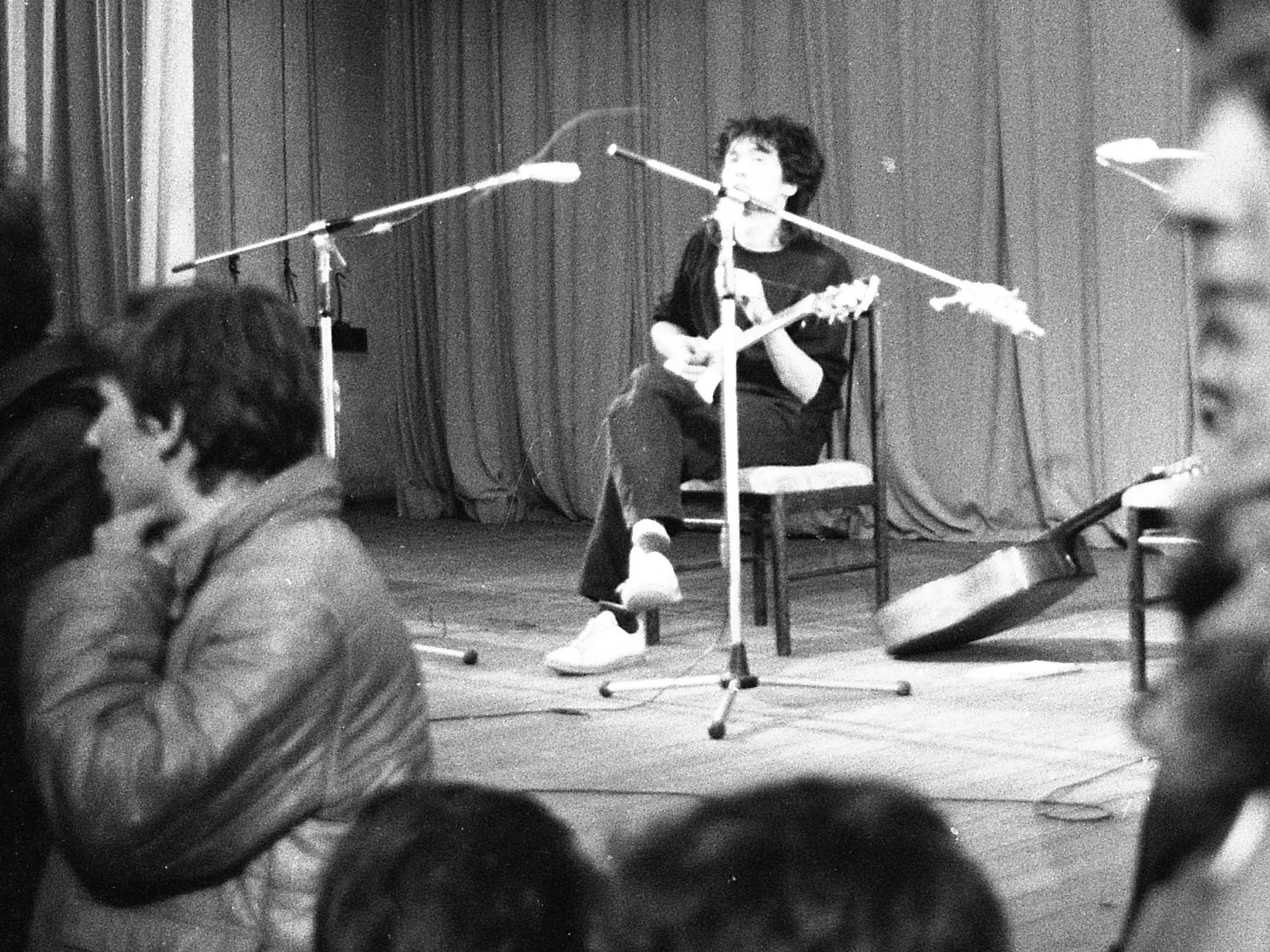
In 1988 the rock magazine RIO asked Viktor Tsoi whether he was afraid to say he made pop music, and he answered: "Yes, I make pop music. Music should cover everything... Music shouldn't only call on people to go and smash up the Winter Palace. It should be listened to." In the same conversation he complained that his song "Changes!" had come to be heard as "a newspaper article about perestroika," although he had written it long before anyone talked about perestroika.
Standing their ground
When Grease was being cast, the names that came up for Sandy included Linda Ronstadt and Marie Osmond. John Travolta, who had already been offered the lead, kept pushing for Olivia Newton-John, a pop star who was nervous about acting on screen. "If you don't see this, you guys are nuts," he recalled in a 1998 interview with Entertainment Tonight, "'cause there was only one person in the world that was Sandy, and that was Olivia Newton-John."
Robert Duvall turned down The Godfather Part III over pay. "If they paid (Al) Pacino twice what they paid me, that's fine, but not three or four times, which is what they did," he told Charlie Rose in 2004. He had his own view of how films should be shot as well: "I don't understand needing 60 or 70 takes. If they think they know what they're looking for, they don't know it when they find it. After two or three, that's when you find it." He paid for The Apostle, which he wrote, directed and starred in, out of his own pocket, $5 million in all, and explained in 1998 that money comes easily only to "the top, top, top guys like (John) Travolta or (Tom) Hanks."
When Steve Carell joined The Office, he already had a fairly specific idea of Michael Scott in his head. "I had a pretty specific take at this point, and it wasn't Ricky Gervais'," he said on the Office Ladies podcast, explaining why he never watched the British original: "I didn't want that to influence whatever this version was going to be." Carell is the second exception: his trait, too, shows up only at his recorded birth time. Olivia Rodrigo's label planned an EP for her debut, and she held out for a full album, one that was "truly reflective of what I can do." Sour came out in 2021.
In the summer of 1928 Anton Makarenko, the Soviet educator who ran the Gorky colony for homeless and delinquent teenagers, was advised by the head of Ukraine's child welfare department to make "minimal concessions" to his critics if he wanted to keep his post. He wrote back that he remained "certain that my version of a children's organization is right" and would "rather be left without work than give up" the organizational discoveries he had made. From September 1 he no longer ran the colony, and he carried on with the same system at the Dzerzhinsky commune.
The people in this article
| Who | Known for | Born | Angle | Window | Whole birthday |
|---|---|---|---|---|---|
| Pablo Picasso | painter | October 25, 1881 | opposition | 4 days | yes |
| Anton Makarenko | educator | March 13, 1888 | square | 5 days | yes |
| Sergei Yesenin | poet | October 3, 1895 | square | 2.5 days | yes |
| Robert Duvall | actor | January 5, 1931 | opposition | 40 hours | yes |
| John Travolta | actor | February 18, 1954 | square | 5 days | yes |
| Anthony Head | actor | February 20, 1954 | square | 5 days | yes |
| Jackie Chan | actor | April 7, 1954 | square | 41 hours | yes |
| John McEnroe | tennis player | February 16, 1959 | square | 27 hours | at birth time |
| Paula Abdul | singer, TV judge | June 19, 1962 | square | 13 days | yes |
| Viktor Tsoi | singer, Kino | June 21, 1962 | square | 13 days | yes |
| Steve Carell | actor | August 16, 1962 | opposition | 27 hours | at birth time |
| Chris Tucker | actor | August 31, 1971 | square | 3 days | yes |
| Olivia Rodrigo | singer | February 20, 2003 | opposition | 31 hours | yes |
Where the method stops
We picked these stories knowing what we were looking for, and almost anyone with a long public life has had arguments on the record. Psychologists call this confirmation bias. Our own numbers add another caveat. Only 0.73% of the famous people in our database have the trait, half the share in the population, and the reason lies in how the database is built. Because more than two-thirds of the people in our database lack a recorded birth time, we count the trait for them only if it held all day, and that happens on roughly a quarter of the days that have it at all. So we see a fraction of the real carriers, mostly those born in the longer windows, and the short-window people like McEnroe only when their birth time is known.
A single trait also doesn't make a character. What shows up in a person's life depends on everything else in the chart, and we left the houses and the Moon out of this piece because they need an exact birth time. This is the third piece in our series on rare traits of famous people, after Mars and Saturn in the same degree and Venus retrograde.
How to check your own chart
Calculate your birth chart with your birth time if you know it. The reading includes the chapter "What's rare in your chart," which shows the rare traits you have, how common each one is and which famous people share them with you. The next window opens on December 3, 2026, when Mercury in Scorpio squares Jupiter in Leo for about a day and a half.