Natal charts
Stellium in a Birth Chart: How Rare It Is and What Counts
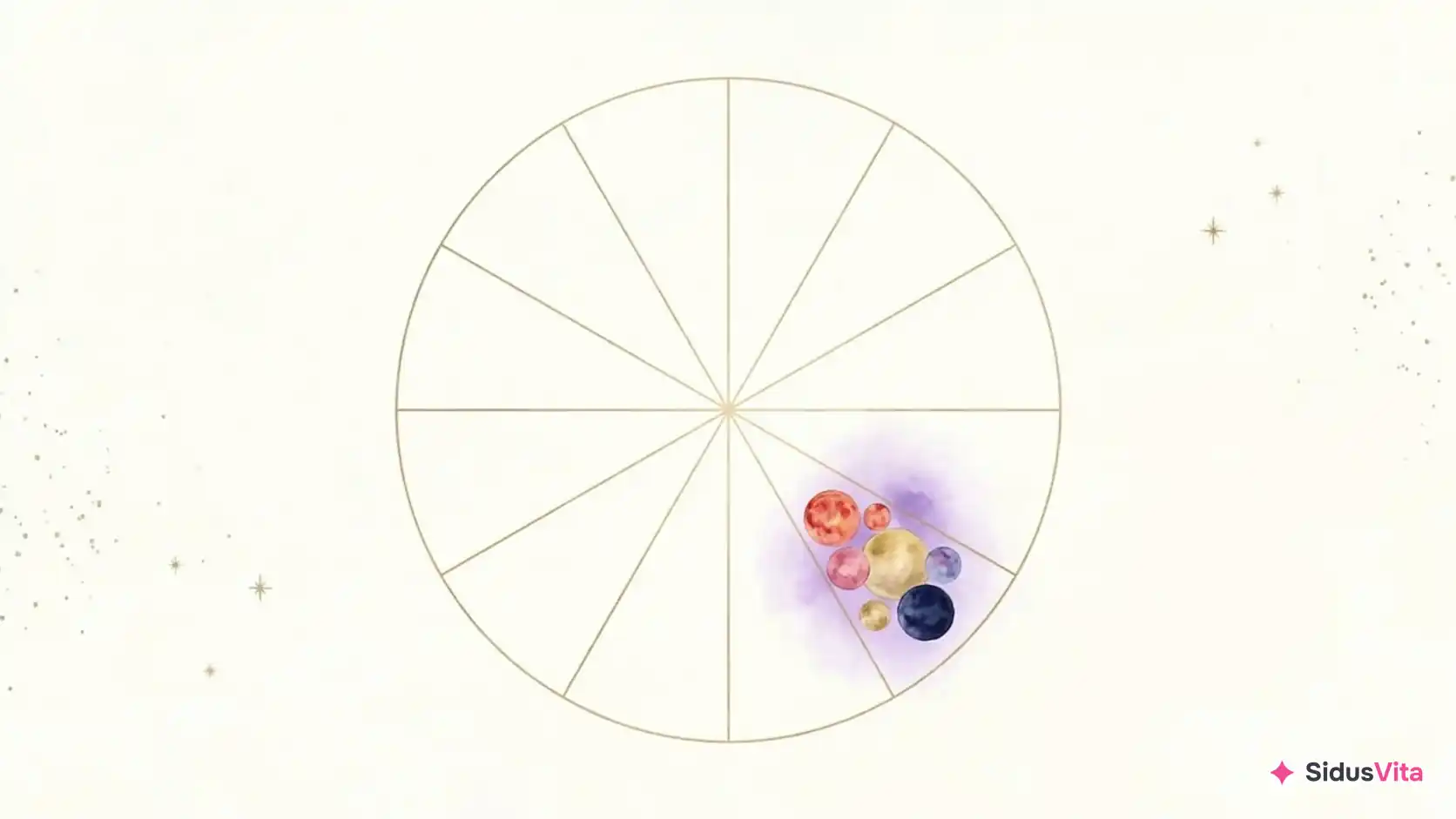
On the afternoon of 3 May 2000 all seven classical planets stood in Taurus: the Sun, the Moon, Mercury, Venus, Mars, Jupiter and Saturn. That is a stellium, a cluster of planets in one zodiac sign or one house of the birth chart, and an extreme one. We generated 100,000 birth charts for random moments between 1950 and 2008, and seven bodies in one sign turned up in 47 of them. Most stelliums are far more ordinary. Count all ten bodies from the Sun to Pluto, and three or more share a sign in 69% of charts, two charts in three. Four or more share a sign in 21%, about one chart in five; five in 4.1%, one in 24. Count only the seven classical planets and three in a sign drops to 44%, four to 8.5%. Sources disagree on the threshold, so two questions matter more than the label: which planets form the cluster, and which year you were born.
How common each size of stellium is
The same sample gives quite different answers depending on the rule. Here are three common ones side by side:
| Planets together | Ten bodies, one sign | Seven classical planets, one sign | Ten bodies, one house (Placidus) |
|---|---|---|---|
| 3 or more | 69.0% | 43.6% | 73.3% |
| 4 or more | 21.1% (1 in 5) | 8.5% (1 in 12) | 28.1% (1 in 4) |
| 5 or more | 4.1% (1 in 24) | 1.0% (1 in 101) | 7.6% (1 in 13) |
| 6 or more | 0.60% (1 in 166) | 0.09% (1 in 1,124) | 1.7% (1 in 58) |
| 7 or more | 0.05% (1 in 2,128) | 0.01% (1 in 9,091) | 0.25% (1 in 403) |
House clusters come out more often than sign clusters in our sample, and they are also the least stable, as the section on birth time shows. If you drop the Moon and count the other nine bodies, four or more in a sign falls from 21.1% to 16.6%. Some authors also add the Ascendant (the degree of the sign rising in the east at the moment of birth) and the Midheaven (the highest point of the chart) to the count; with those two points and the seven classical planets, three or more in a sign appear in 58.4% of charts.
What counts as a stellium
The French reference site Astrotheme describes the usual rule as three planets, sometimes four if one of them is the Sun, the Moon or a slow planet, and says plainly that both thresholds are in use. Three planets in one house can also count when they sit in different signs. In SidusVita, the "What's rare in your chart" chapter counts the ten bodies from the Sun to Pluto and starts at four in one sign or four in one Placidus house. Five or more in a sign is treated as a separate, rarer trait.
Why do some writers want four? Because a three-planet cluster forms quite easily. Seen from Earth, Mercury never gets more than about 28° from the Sun, and Venus never more than about 47°. So these two often sit in the Sun's own sign. In our sample the Sun belongs to 44% of all clusters of exactly three bodies, and 10% of those clusters are precisely the Sun, Mercury and Venus. Among clusters of four or more, the Sun takes part in 70%.
The stellium you share with your classmates
Slow planets are the other half of the story. In 54% of clusters with four or more bodies, at least two are slow planets from Jupiter to Pluto, and in 28% at least two of the three outer ones: Uranus, Neptune and Pluto. Clusters made only of personal planets (Sun, Moon, Mercury, Venus, Mars) are 8.8% of them. Outer planets stay in one sign for years, so many people born in the same period share them, and the share of four-body stelliums jumps from one birth year to the next:
| Birth year | 4 or more in one sign | 5 or more in one sign | Sign of the cluster in most of those charts |
|---|---|---|---|
| 1975 | 2.2% | none in our sample | Libra (41%) |
| 1977 | 6.2% | none in our sample | Libra (43%) |
| 1981 | 41.9% | 8.6% | Libra (67%) |
| 1983 | 23.0% | 3.9% | Sagittarius (83%) |
| 1989 | 38.8% | 9.8% | Capricorn (89%) |
| 1990 | 42.7% | 22.2% | Capricorn (83%) |
| 1999 | 8.8% | 0.6% | Aquarius (96%) |
| 2000 | 23.9% | 4.2% | Taurus (34%) |
In 1989 and 1990 Saturn, Uranus and Neptune all stood in Capricorn. A Capricorn stellium in a 1990 chart is a generation marker before it is anything personal. The rare-traits chapter handles this by comparing every trait twice: with all charts, and with people born within two years either side of you. If peers have the trait at least three times as often, and fewer than 20% of all people have it, the chapter moves it into the part about your generation. By the chapter's own table, four bodies in Capricorn appear in 3.8% of all charts and in 21.5% of people born 1988–1992, 5.6 times as often.
Back to 3 May 2000: one chart, several answers
Take a hypothetical chart for that day, not a real person: 2 pm British Summer Time in London. The Sun was at 13.4° Taurus, the Moon at 4.8°, Mercury at 6.9°, Venus at 3.0°, Mars at 29.8°, Jupiter at 16.8° and Saturn at 19.5°.
- By the ten-body rule that is seven in one sign, a level reached by 47 charts in our 100,000.
- By the seven-planet rule it is every classical planet in one sign, which happened in 11 charts of the sample. Checking every day of 2000 at noon Universal Time, only one day had all seven in a single sign.
- It did not last. Mars sat in the last degree of Taurus and crossed into Gemini at 19:19 UT, so a baby born in London after 8:19 pm the same evening would have six bodies in Taurus.
- The house picture moves faster. At 2 pm six bodies (Sun, Moon, Mercury, Venus, Jupiter and Saturn) share the 9th house. Twelve hours later the sign cluster still holds six bodies, but the house cluster is five bodies in the 3rd house.
The slow part of this chart is Jupiter with Saturn. The two meet roughly every 20 years, and their conjunction of 28 May 2000 fell in Taurus, so many people born that spring have several planets in Taurus. Among people born 1998–2002 the chapter table finds four bodies in Taurus 3.3 times as often as in the whole population. The personal part is what the Sun, Moon, Mercury and Venus add, and how close they sit: the tightest pairs are the core that astrologers traditionally read first.
Stelliums in houses need an accurate birth time
Houses divide the chart by the Earth's daily rotation, so a house stellium depends on the hour and the place. We tested how often clusters survive an uncertain birth time by moving it in both directions and checking that the same house or sign still held at least four bodies. A four-body house cluster survived a 15-minute shift in 54% of cases and a one-hour shift in 6%. A four-body sign cluster survived a 12-hour shift in 85% of cases, and in 93% once the Moon is left out. In our sample the 6th house holds a four-body cluster most often (3.7% of charts) and the 10th and 11th least often (1.5% each); the chapter's own table, built on a different sample, also puts the 6th first and the 10th last.
The practical rule follows: a sign stellium can usually be discussed even without an exact birth time. For a house stellium, if the time is uncertain, check whether the cluster holds across the whole interval in which the birth could have happened.
How to read a stellium in your own chart
- Open your birth chart and count the bodies in each sign. If you know your birth time, do the same for the houses.
- Look at the members. The Sun with Mercury and Venus is a frequent trio. Two or more slow planets means your birth year matters, so check the table above.
- Find the core: the planets packed closest together, usually within a few degrees. Tradition reads the whole cluster through them, and through the ruler of the sign.
- If the sign matches your generation's, treat it as shared and look for what is yours in the personal planets that joined it and in the house they occupy.
Astrological tradition says a stellium concentrates attention on the themes of its sign or house: many planets in one place mean many matters gathered there. That is interpretation; the frequencies above are measurement. The "What's rare in your chart" chapter of the natal reading does the counting for a specific chart, against all charts and against your peers. For more rarity numbers by sign, see how rare each Venus and Mars sign is. Clusters also show up in yearly charts. In a solar return reading, a cluster in the 4th, 5th, 9th or 11th house of the year is one of the reasons that area gets its own card (a report has two such cards at most): four planets in the house are reason enough, while a three-planet cluster needs one more indicator, such as the year's Sun in that house.
What the numbers do not say
The sample is artificial: birth moments are spread evenly across years and hours, which real births are not. Shares among real births can therefore differ, sign shares included, because they depend on the birth year and births are not spread evenly across years; for houses the hour of birth matters as well. Houses were calculated for ten mid-latitude cities, from Moscow and Almaty to London and New York, and other latitudes would give slightly different shares. A frequency tells you how ordinary a cluster is, nothing about character. All positions come from the Swiss Ephemeris, the planetary tables our calculator uses, in the tropical zodiac; the settings are listed on our methodology page.