Natal charts
How to Read Astrocartography: Planetary Lines, Angles and Distance
An astrocartography map redraws your birth chart across the globe. For each of ten planets it draws four lines through the places where, at the minute you were born, that planet was rising in the east (ASC), setting in the west (DSC), crossing the meridian at its highest (MC) or at the nadir beneath your feet (IC). Reading it comes down to three questions about a place you care about. Which lines pass within 600 km? What does each one combine: a planet's theme, such as love for Venus or duty for Saturn, with the angle's area of life, which is yourself for the ASC, work for the MC, partners for the DSC and home for the IC? And how close is it? Our calculator counts a line at full strength up to 150 km, fading out by 600 km. Before trusting any of it, check how exact your birth time is and which of the two common methods drew the lines.
Two straight lines and two curves
The modern method was developed and popularised by the astrologer Jim Lewis in the 1970s and 1980s. His maps show every place on Earth where a planet was angular at the moment of birth, meaning it sat exactly on one of the four angles of the chart. You know those angles from a birth chart: the Ascendant is the degree of the zodiac rising on the eastern horizon, the Descendant is the point opposite it in the west, the MC is the top of the sky and the IC is the point directly below. In your birthplace a planet usually sits somewhere between the angles. The world map shows where, at that same minute, it sat exactly on one of them.
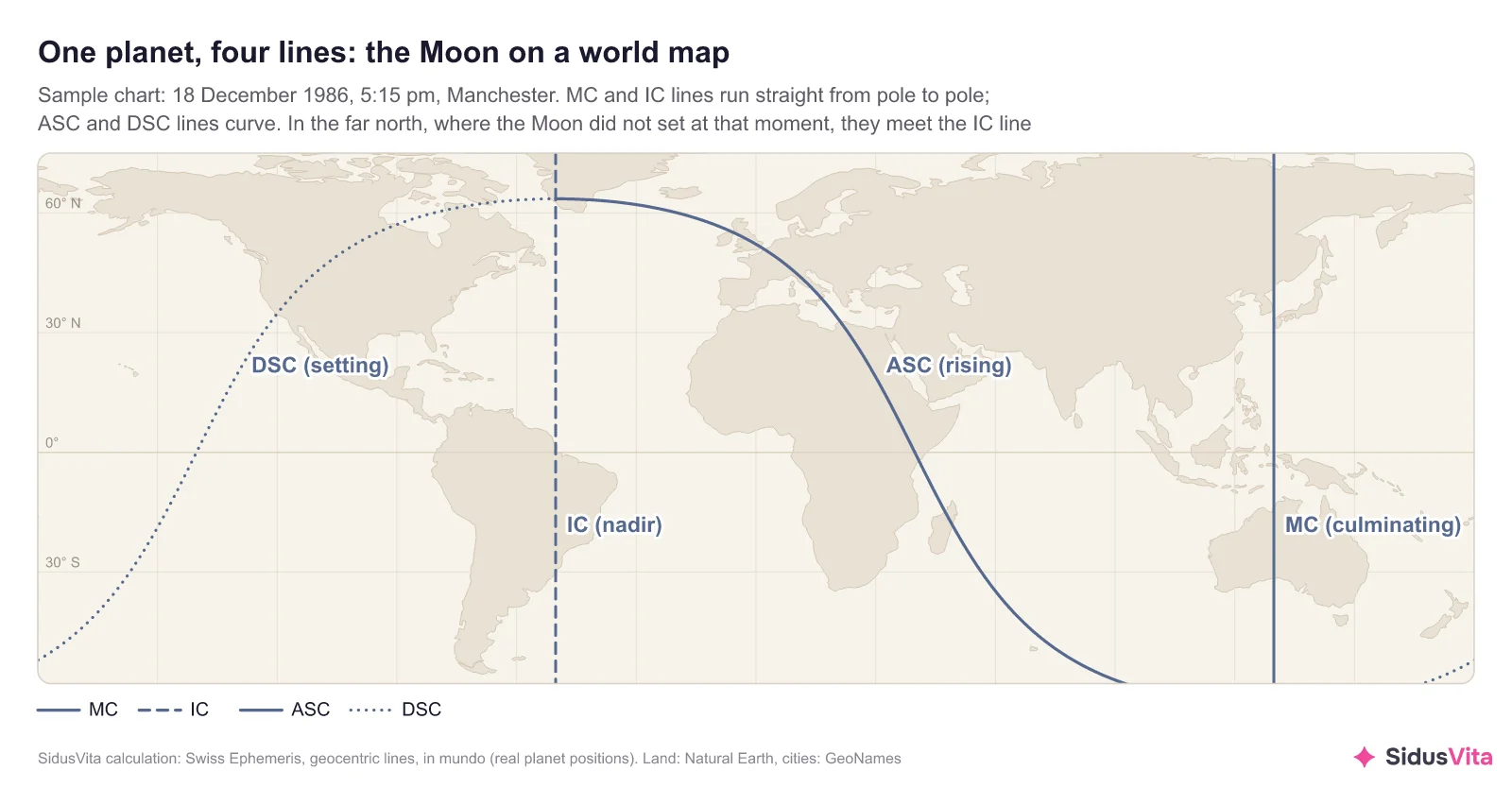
The MC line is the simplest. A planet reaches its highest point of the day when it crosses the meridian, the line in the sky that runs due north and south, so it culminates at the same minute along a whole strip of the Earth from pole to pole. On a flat world map that strip is a vertical line. It is sometimes called the zenith line, although the planet stands straight overhead at only one latitude along it. The IC line is another vertical, exactly 180 degrees of longitude away on the other side of the globe.
Rising and setting depend on latitude as well as longitude, which is why those lines bend. In June the Sun comes up earlier in Oslo than in Rome, which lies at almost the same longitude, and in December it comes up later; every planet behaves the same way. Where a planet did not rise or set at all at that moment, the way the Sun stays up through a polar summer, the curve stops and joins the MC or IC line.
What the planet and the angle each add
The angle tells you which part of life gets louder. The 40 texts in our calculator use the same split, and so does the goal filter on the map.
- ASC, rising: you yourself, how you feel in a place and how people read you there. Near a Sun ASC line, in the calculator's words, "you carry yourself with more confidence and speak in the first person more easily".
- MC, culminating: work, reputation and what you are known for. Your work is on display there, and more is expected of you.
- DSC, setting: partners, alliances and the people close to you. That is why the map's "Love and relationships" goal shows every DSC line plus all the Venus lines.
- IC, nadir: home, family and a sense of roots, the places where it is easier to settle in.
The planet sets the theme. Here is each one in brief, with a line title from the calculator.
| Planet | Theme | Line title in the calculator |
|---|---|---|
| Sun | being seen, confidence, a role of your own | Sun MC line: a place where you are seen |
| Moon | feelings, care, a sense of home | Moon IC line: a place that feels like home |
| Mercury | words, study, agreements | Mercury MC line: words as a profession |
| Venus | love, taste, pleasure | Venus DSC line: the line of love |
| Mars | drive, courage, rivalry | Mars DSC line: passionate, complicated bonds |
| Jupiter | growth, generosity, opportunity | Jupiter DSC line: generous partners |
| Saturn | responsibility, long effort | Saturn DSC line: serious commitments |
| Uranus | change, freedom, sudden turns | Uranus IC line: home on the move |
| Neptune | imagination, sensitivity, idealisation | Neptune MC line: work of the imagination |
| Pluto | deep change, influence, high stakes | Pluto MC line: influence and high stakes |
Every one of the 40 texts follows the same pattern: what gets louder near the line, what comes more easily and what will take effort. A Saturn line reads as a place where results cost patience, and a Venus line has its price too. For the Venus DSC line that price is "expecting love to solve everything: it is easier to choose a pleasant person than the right one." All of this is a tradition of interpretation that our texts carry on, and none of it is a measurement.
How close is close
A line is the middle of a band with soft edges. In the SidusVita calculator its theme is at full strength up to 150 km away, weakens beyond that and fades out by 600 km. Every distance on the page follows from that: "My cities" lists the lines within 600 km of each place, and each line card lists up to five major cities within 300 km. Distance is measured to the nearest point of the line along the Earth's surface.
It helps to turn those kilometres into minutes of birth time. At London's latitude, 150 km is about nine minutes of error and 600 km about 35 minutes. If you only know your time to the nearest quarter of an hour, a line 50 km from a city and a line 150 km away are inside the same margin.
For each city the calculator also asks a second question, in degrees. It recasts your birth chart for that place and lists the planets within 5 degrees of the new Ascendant, Descendant, MC or IC. The two answers can differ, and the example below shows why.
A sample chart, step by step
Take a sample birth: 18 December 1986, 5:15 pm, Manchester. The chart belongs to no real person: we chose the date because one map then shows several different cases. You can enter it in the calculator and check the numbers, which come from the same code that runs the page; they may differ by a few kilometres if the city search picks slightly different coordinates. The table uses both methods explained further down: in mundo, from the planet's real position in the sky (our default), and zodiacal.
| City | Lines within 600 km, in mundo | Same city, zodiacal method | Planets on the angles in the recast chart |
|---|---|---|---|
| Manchester (birthplace) | Moon ASC 8 km; Mars MC 227 km; Jupiter MC 246 km | Mars MC 207 km; Jupiter MC 214 km; Moon ASC 441 km | Mars on the MC (3.4°), Jupiter on the MC (3.5°) |
| London | Moon ASC 57 km; Mars MC 91 km; Jupiter MC 111 km | Mars MC 70 km; Jupiter MC 77 km; Moon ASC 493 km | Mars on the MC (1.1°), Jupiter on the MC (1.2°) |
| Toronto | Sun MC 16 km; Jupiter ASC 202 km; Mars ASC 255 km; Uranus MC 339 km | Sun MC 16 km; Jupiter ASC 330 km; Mars ASC 335 km; Uranus MC 338 km | Sun on the MC (0.2°), Uranus on the MC (3.9°) |
| Barcelona | Jupiter MC 57 km; Mars MC 81 km; Neptune DSC 258 km | Jupiter MC 97 km; Mars MC 106 km; Neptune DSC 334 km | Jupiter and Mars on the MC (1.3°, 1.4°), Neptune on the DSC (4.0°) |
| Lisbon | Sun DSC 56 km; Uranus DSC 358 km | Sun DSC 56 km; Uranus DSC 350 km | Sun on the DSC (0.7°), Uranus on the DSC (4.4°) |
| Berlin | none | Moon ASC 305 km | Moon on the ASC (4.0°) |
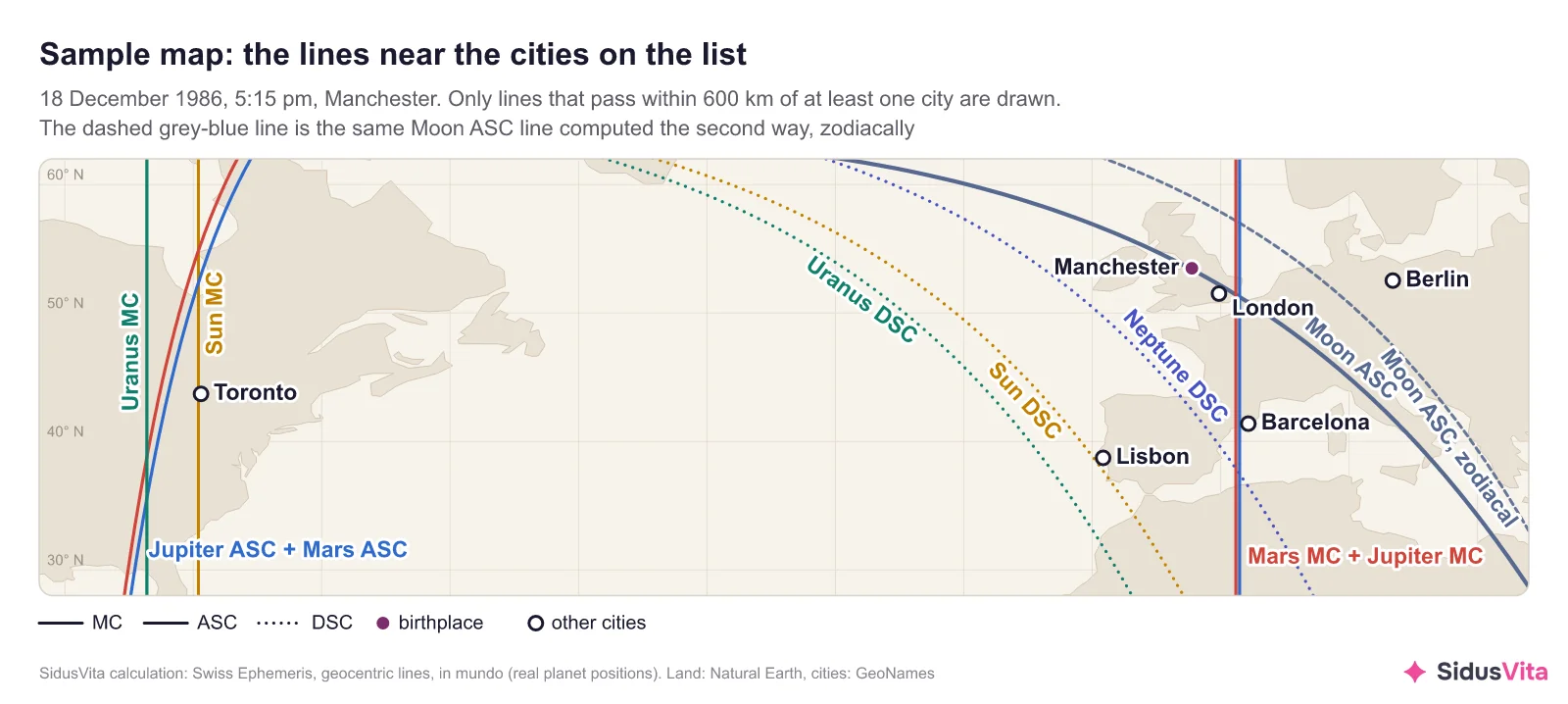
Start at home. The Moon ASC line runs 8 km from Manchester, so the place of birth already sits on a line at full strength. The calculator's card for it is called "Moon ASC line: feelings on the surface" and begins: "Near this line, feelings and intuition get louder: you are softer, more open and quicker to respond to people."
Read the cleanest case. In Toronto the Sun MC line passes 16 km from the city, both methods agree, and in the recast chart the Sun sits 0.2 degrees from the MC. When distance, method and degrees all say the same thing, the reading is as clear as this map gets: "Sun MC line: a place where you are seen", where work and recognition get louder.
Read lines that travel together. Mars and Jupiter stand a tenth of a degree apart in Pisces in this chart, so their MC lines run side by side, through London at 91 and 111 km and Barcelona at 81 and 57 km. Read them as a pair: drive and the fight for results from Mars, growth and open doors from Jupiter. In London the Moon ASC line is close too, at 57 km, which puts three themes in one city.
Let a single line stand on its own. Lisbon has one line in its core zone, the Sun DSC at 56 km, and the two methods agree on it. That card reads "Sun DSC line: bright people around you", and its fuller text also names the catch: "It matters to keep your own path from dissolving into someone else’s."
Notice when the map and the city card disagree. Berlin has no line within 600 km in mundo, yet the recast chart puts the Moon 4 degrees from the Ascendant. Both are correct. The list of planets on the angles works from zodiac degrees, while the map uses the method you choose, and at this birth the Moon stood 5 degrees north of the ecliptic. The section below explains why that one fact moves a line by hundreds of kilometres.
Same line, two methods
There are two common ways to draw a line. The first, called in mundo, takes the planet where it actually stands in the sky, including how far it sits above or below the ecliptic, the Sun's apparent path. It is the default on astro.com and in our calculator. The second, zodiacal, keeps only the planet's zodiac degree and draws the line where that degree rises, sets or culminates. The Sun always sits on the ecliptic, so for the Sun both methods give the same line. The other planets wander off it: in our sample of moments from 1950 to 2010 the Moon reached 5.3 degrees, Venus 8.7, Mars 6.7 and Pluto 17.7. The further a planet strays, the more its ASC and DSC lines move when you switch methods.
To put sizes on it, we took 3,000 random moments between 1950 and 2010 and measured how far each line shifts between the methods at latitude 50 degrees north, roughly the latitude of Prague or Winnipeg.
| Line | Typical shift (median) | 95% of moments | Largest |
|---|---|---|---|
| Sun, any angle | 0 km | 0 km | 0 km |
| Moon MC | 59 km | 137 km | 151 km |
| Moon ASC | 303 km | 606 km | 706 km |
| Mercury ASC | 163 km | 368 km | 524 km |
| Venus MC | 27 km | 118 km | 236 km |
| Venus ASC | 124 km | 541 km | 921 km |
| Mars ASC | 94 km | 372 km | 799 km |
| Jupiter ASC | 70 km | 150 km | 175 km |
| Saturn ASC | 137 km | 274 km | 304 km |
| Pluto ASC | 863 km | 1,056 km | 1,084 km |
In the sample chart the Moon ASC line sits 8 km from Manchester in mundo and 441 km away zodiacally. Neither method is wrong: one shows where the Moon itself crossed the horizon, the other where its zodiac degree did. If you compare your map on two sites, check which method each one uses before comparing anything else.
What a wrong birth time costs
The Earth turns once relative to the stars in 23 hours 56 minutes 4 seconds, which comes to about one degree every four minutes. Every line moves west with it. A degree of longitude is 111 km at the equator and narrows towards the poles, so the same error costs fewer kilometres further north.
| Time error | Equator | New York (40.7°) | London (51.5°) | Manchester (53.5°) |
|---|---|---|---|---|
| 4 minutes | 111 km | 85 km | 69 km | 66 km |
| 15 minutes | 418 km | 317 km | 260 km | 249 km |
| 1 hour | 1,672 km | 1,268 km | 1,041 km | 995 km |
Those are the figures for the slow planets, Jupiter to Pluto. Sun lines move a little less, 1,038 km an hour at London's latitude, and Moon lines less again, 1,003 km, because the Moon moves east across the sky by about half a degree in that hour.
In the sample chart, London sits 57 km from the Moon ASC line. Had the birth been at 5:00 pm instead of 5:15, the line would lie 222 km from London; at 5:30 pm, 118 km. That is why the calculator draws no map without an exact time, and why choosing "approximate, ±15 minutes" turns every line into a band.
What the map cannot tell you
The map will not name a best city to live in. It shows which themes get louder in a place, and it is a good way to look back at places you already know: add the cities where you have lived or spent long stretches to "My cities" and compare the line texts with what you remember. Watch for selective memory too: a trip that matched a line is easy to count as proof, and the ones that did not are easy to forget.
A line describes a leaning. If one catches your eye, visit first and stay a while before deciding anything bigger. The calculator puts it plainly under the map: "Whether to move is your call: visas, work and the people you love matter more than lines."
You can draw your own lines in our astrocartography calculator. It needs your birth date, exact time and city; the map and "My cities" are free without an account, and the full line texts open after a free sign-in. To get to know the chart itself first, with the signs and houses of your planets, start with the birth chart. If your question is about a single year, that is a solar return: you can spend your birthday in another city and the year's chart changes with it, as our article on solar return location explains.