Natal charts
7th House Astrology: Meaning, Planets, and Why It Is Often Empty
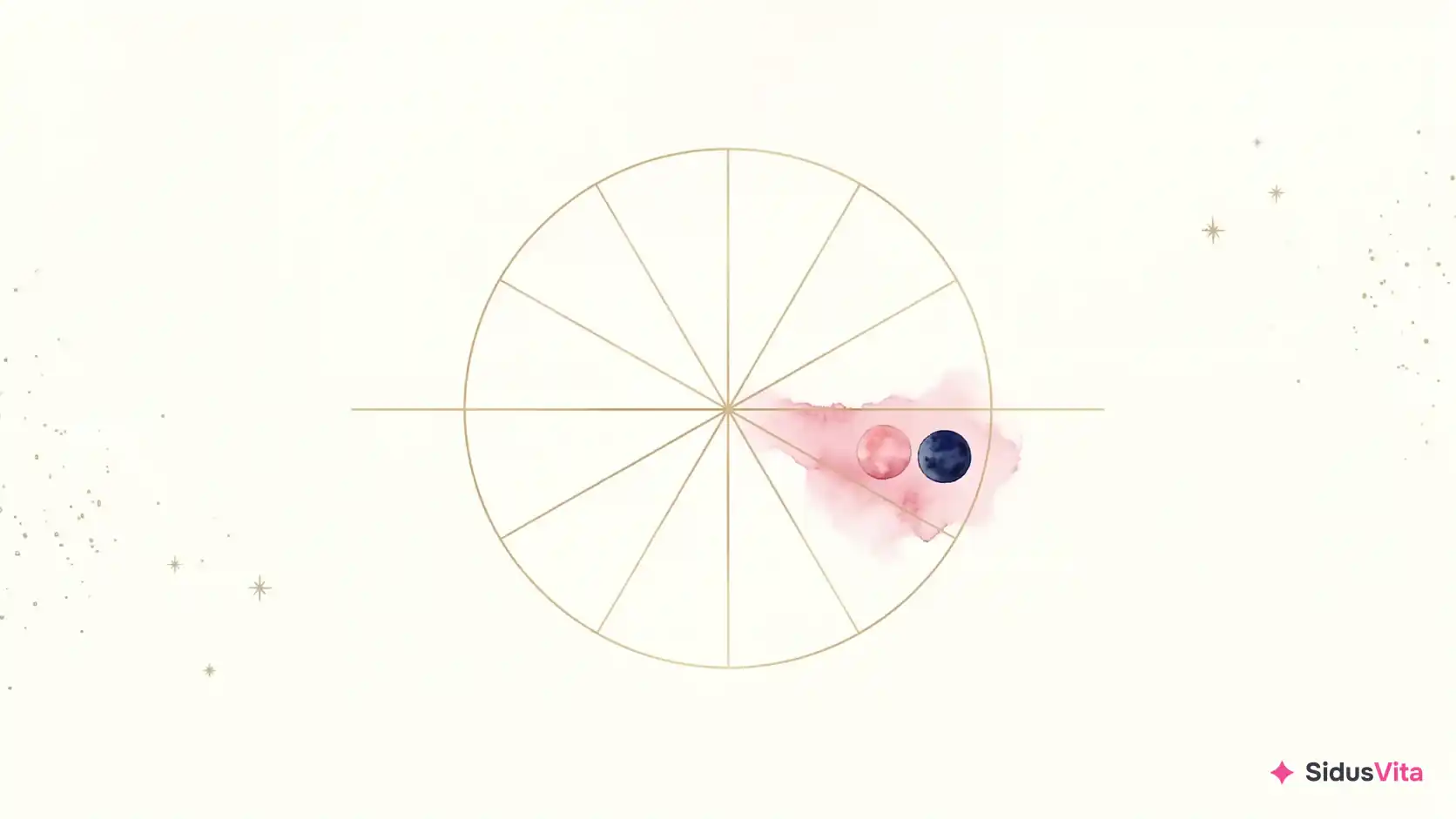
In 7th house astrology, this sector of the birth chart represents committed partnership, marriage, formal contracts, and open rivals. It begins at the Descendant (the exact degree setting on the western horizon at the moment of birth, directly opposite the Ascendant, or rising degree). People looking up marriage in a birth chart often worry when they see no planets there, yet an empty 7th house is actually the statistical norm. Across 100,000 charts generated for random moments between 1950 and 2008, the 7th house is empty in 51.35% of cases and holds at least one of the ten bodies from the Sun to Pluto in 48.65%. Three or more bodies gather there in 7.32% of charts. When the house has no planets, astrologers read partnership themes through the zodiac sign on its cusp (the starting boundary of the house) and the ruler (the planet associated with that sign).
What the 7th house means in astrology
A birth chart divides the sky into twelve sectors called houses, based on the exact time and place of birth. The first six houses sit below the horizon, starting from the Ascendant in the east. The 7th house is the first sector above the western horizon, beginning at the Descendant. Because it directly opposes the 1st house of self and physical presence, traditional astrology assigns the 7th house to "the other"—any person you meet face to face as an equal or an opponent.
In the tradition, this covers several distinct areas of life:
- Marriage and long-term partnership: spouses, committed live-in partners, and the general dynamic a person brings to one-on-one unions.
- Business partners and formal agreements: co-founders, legal contracts, clients, and negotiations where terms are stated openly.
- Open rivals and lawsuits: competitors, opponents in court, and anyone with whom you have a declared conflict, in contrast to the hidden matters that astrologers place in the 12th house.
A birth chart describes the style and recurring themes of partnerships rather than a schedule of events. Whether someone marries early, late, or at all is outside what a house placement can measure. Here it helps to keep a clear line between two things: a frequency in our sample is an astronomical measurement, while the meaning of a placement is the astrological tradition's interpretation.
How often the 7th house is empty
Ten celestial bodies (the Sun, the Moon, and the eight planets from Mercury to Pluto) have to be distributed across twelve houses. By simple arithmetic, every chart has empty houses. In our sample of 100,000 charts using Placidus houses (the most common system of unequal house division), the average chart has 5.79 empty houses. Every single chart in the sample has at least two empty houses, and the maximum is ten. Having six empty houses is the most common outcome, appearing in 33.57% of charts, followed by five empty houses in 27.48% and seven in 20.30%.
Comparing all twelve houses side by side shows that the 7th house is empty slightly more often than any other sector in this 1950–2008 sample:
| House | Empty (%) | Occupied by 1+ bodies (%) | 3 or more bodies (%) |
|---|---|---|---|
| 1st house | 46.56% | 53.44% | 8.24% |
| 2nd house | 46.22% | 53.78% | 8.02% |
| 3rd house | 46.63% | 53.37% | 8.06% |
| 4th house | 47.07% | 52.93% | 8.38% |
| 5th house | 48.23% | 51.77% | 8.74% |
| 6th house | 50.24% | 49.76% | 9.32% |
| 7th house | 51.35% | 48.65% | 7.32% |
| 8th house | 49.37% | 50.63% | 6.83% |
| 9th house | 48.82% | 51.18% | 6.43% |
| 10th house | 48.19% | 51.81% | 6.10% |
| 11th house | 47.78% | 52.22% | 6.08% |
| 12th house | 48.23% | 51.77% | 6.34% |
More than half of all charts—51.35%, or roughly one in two—have an empty 7th house. Only the 6th house (50.24% empty) joins the 7th above the 50% mark, while the 2nd house is the most frequently occupied at 53.78%. A cluster of three or more bodies in the 7th house turns up in 7.32% of charts, roughly one in fourteen.
How astrologers read an empty 7th house
An empty 7th house does not mean a life without relationships. In traditional astrology, a house without planets is simply a room where the permanent furniture is described by the sign on the door and the owner of the building. Astrologers read it in three steps:
- Check the sign on the 7th house cusp (the Descendant). Every 7th house begins in one of the twelve zodiac signs. Astrologers read the qualities of that sign as the baseline atmosphere of your partnerships and the traits you naturally notice in other people.
- Find the ruler of that sign. In the tradition, each zodiac sign has a planetary ruler—for example, Mars rules Aries, Venus rules Taurus and Libra, and Saturn rules Capricorn. If your Descendant is in Capricorn, Saturn is the ruler of your 7th house, operating in much the same way the 1st house ruler acts as the chart ruler.
- Look at the ruler's sign, house, and aspects. An aspect is a specific geometric angle between two planets on the zodiac circle. Where the 7th house ruler sits in the chart shows which area of life connects to your partnerships. For instance, if the ruler of the 7th house stands in the 10th house of career and public standing, astrologers traditionally link partnership themes with professional life or status.
Planets in the 7th house: frequencies and traditional meanings
When a chart is among the 48.65% that do have at least one body in the 7th house, which planet is it? If a single body moved at a uniform speed around the zodiac and houses were all equal, it would spend 8.33% of its time (one twelfth) in each house. In our 1950–2008 sample, the Sun, Moon, and inner planets stay very close to that one-twelfth baseline in the 7th house, while the slowest outer planets appear there less often than in the first six houses:
| Celestial body | In the 7th house (%) | Lowest house share (%) | Highest house share (%) |
|---|---|---|---|
| Venus | 8.48% | 8.16% (4th) | 8.48% (7th) |
| Mars | 8.47% | 8.03% (3rd) | 8.62% (8th) |
| Sun | 8.44% | 8.17% (2nd) | 8.44% (7th) |
| Moon | 8.36% | 8.22% (3rd) | 8.47% (11th) |
| Jupiter | 8.26% | 8.22% (10th) | 8.47% (9th, 11th) |
| Mercury | 8.22% | 8.16% (12th) | 8.62% (4th) |
| Saturn | 8.12% | 8.12% (7th) | 8.55% (4th) |
| Uranus | 7.49% | 7.44% (11th) | 9.18% (3rd) |
| Pluto | 7.37% | 7.37% (7th) | 9.38% (2nd) |
| Neptune | 6.05% | 5.88% (9th) | 10.87% (4th) |
Venus (8.48%), Mars (8.47%), and the Sun (8.44%) are the three bodies most often found in the 7th house in our sample, each showing up in roughly one chart in twelve. Neptune is the least common there at 6.05% (about one in seventeen), while appearing in 10.51% to 10.87% of charts across the 1st through 6th houses. Uranus, Neptune, and Pluto all have lower shares in houses 7 through 12 than in houses 1 through 6 in this 1950–2008 mid-latitude sample.
When personal bodies occupy the 7th house, traditional texts read them as direct actors in how a person approaches partnerships:
- Venus in the 7th house (8.48% of charts): Venus is the planet traditionally associated with affection, harmony, and agreement. Astrologers read Venus here as a strong emphasis on peaceable relations, diplomacy, and seeking a pleasant, cooperative bond in marriage or business.
- The Sun in the 7th house (8.44% of charts): Because the 7th house sits just above the western horizon, a 7th-house Sun means the person was born shortly before sunset. In the tradition, the Sun represents vitality and focus; placed in the 7th, it is read as a tendency to define oneself through one-on-one commitments, partnerships, and public dealings with others.
- Mars or Saturn in the 7th house (8.47% and 8.12% of charts): Traditional authors read Mars here as bringing directness, competition, or lively debate into relationships and contracts. Saturn in the 7th is traditionally read as taking commitments seriously, preferring formal rules, or approaching marriage with caution and a focus on longevity.
Why the 7th house requires an exact birth time and how to check yours
Because houses are set by the Earth's daily rotation on its axis, the degree of the Descendant moves through all twelve signs of the zodiac every 24 hours—roughly one degree every four minutes. Without an exact birth time, the 7th house cannot be determined: a chart cast for noon when you were actually born in the morning will put the wrong sign on the 7th house cusp and place your planets in the wrong houses.
If you know your birth time, you can check your own 7th house and how another person's chart interacts with it:
- Open the birth chart page and enter your birth date, exact time, and city. It requires no registration and gives the positions and descriptions of your planets, the Moon, and your current period.
- The 7th house begins at the Descendant, directly opposite the Ascendant. Planets in this house are part of its traditional interpretation. If you have three or more planets there (which happens in 7.32% of charts) or another unusual placement, the paid full reading includes a "Rare in your chart" chapter that compares your traits against all charts and against peers born within two years of you.
- If the 7th house is empty, check the sign on its starting line (the Descendant) and find where the planetary ruler of that sign is placed by sign and house.
- When comparing two people's charts in synastry, astrologers also look at house overlays—whether a partner's Sun, Moon, Venus, or Mars falls into the degrees of your 7th house. In the tradition, another person's planets landing in your 7th house bring partnership themes to the foreground between the two of you, even when your own natal 7th house is empty. Our free synastry check shows the share of harmonious connections and the aspects between the personal points of two charts, with the complete interpretation available in Plus.
What these numbers don't tell you
Our sample of 100,000 charts is synthetic: birth dates and hours are distributed uniformly between 1950 and 2008. Real human births are uneven across both decades and times of day, so exact percentages in a census population can differ slightly. All houses were calculated in the Placidus system for ten mid-latitude cities (London, New York, Berlin, Moscow, Saint Petersburg, Minsk, Kyiv, Tbilisi, Almaty, and Novosibirsk); locations much closer to the equator or the polar circles produce different house sizes and slightly different occupancy rates. Most importantly, a frequency measures how common a placement is in the sky, and says nothing about your character, compatibility, or whether a marriage will last. All planetary positions and house cusps were computed using the Swiss Ephemeris (high-precision tables of planetary positions) in the tropical zodiac; the exact settings are documented in our calculation notes.