Natal charts
12th House Astrology: Meaning, Planets, and How Often It Is Occupied
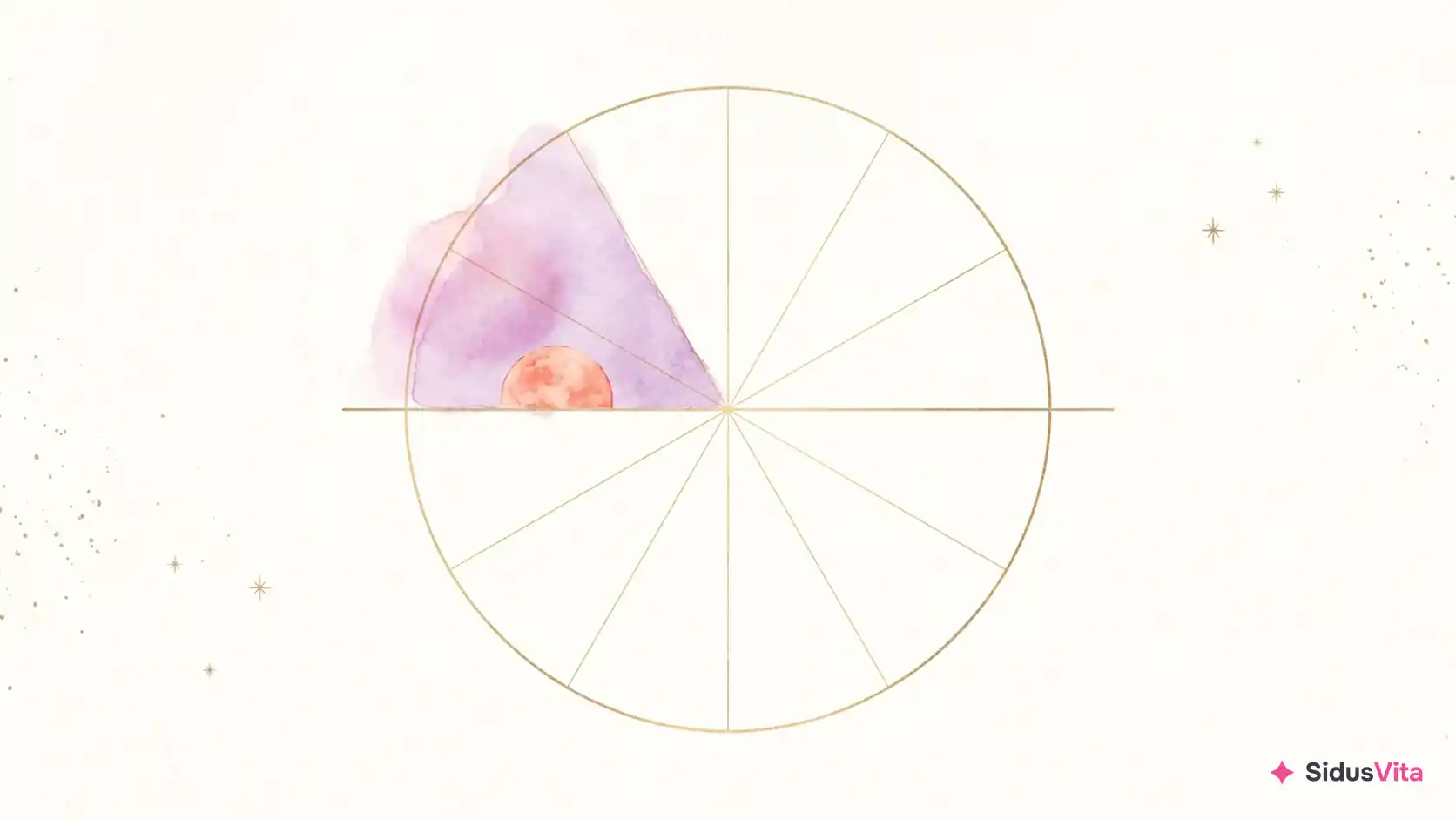
The 12th house is the final sector of the birth chart, sitting just above the Ascendant (the degree of the zodiac rising on the eastern horizon at the moment of birth, which marks the start of the 1st house). Astrological tradition associates the 12th house with solitude, rest, recovery, hidden matters, hospitals, secluded places, and everything done without witnesses; modern astrologers add the subconscious mind. Across 100,000 random birth charts calculated between 1950 and 2008 using the Placidus house system (the most common method of dividing the chart by time and latitude), 51.77% have at least one of the ten bodies from the Sun to Pluto in the 12th house. The remaining 48.23% have an empty 12th house. Three or more bodies gather there in 6.34% of charts, and the Sun appears in the 12th house in 8.39% of charts, occurring in births during the hours after sunrise.
What the 12th house means in tradition
Houses divide the sky into twelve sectors relative to the horizon and meridian at a specific time and place on Earth. The 1st house begins at the Ascendant and extends downward below the eastern horizon. The 12th house lies immediately above the Ascendant, making it the last house of the wheel and the first sector above the eastern horizon.
Because a placement's frequency is a mathematical measurement while its meaning is a matter of astrological tradition, it helps to separate the two. In classical astrology, the 12th house is read as the place of withdrawal and unseen activity. Traditional texts link it to solitude, quiet retreats, hospitals, monasteries, and other institutions cut off from everyday public life. Astrologers also read this sector as governing confidential affairs, private rest, recovery after effort, and actions carried out behind closed doors without an audience.
Twentieth-century and contemporary authors expanded this vocabulary. Modern astrology connects the 12th house to the subconscious, dreams, private reflection, and the inner life that a person keeps away from public view. Whether an astrologer uses classical or modern terms, the core theme remains privacy and withdrawal from the visible world.
How the 12th house compares with the rest of the chart
Ten celestial bodies (the Sun, the Moon, and the eight planets from Mercury to Pluto) distributed across twelve houses cannot fill every sector of a birth chart. In our sample of 100,000 random moments between 1950 and 2008, an average birth chart has 5.79 empty houses, and every single chart in the sample has at least two empty houses.
Here is how often each of the twelve Placidus houses contains at least one body, stays empty, or holds a cluster of three or more bodies:
| House | Occupied (1+ bodies) | Empty (0 bodies) | 3 or more bodies |
|---|---|---|---|
| 1st house | 53.44% | 46.56% | 8.24% |
| 2nd house | 53.78% | 46.22% | 8.02% |
| 3rd house | 53.37% | 46.63% | 8.06% |
| 4th house | 52.93% | 47.07% | 8.38% |
| 5th house | 51.77% | 48.23% | 8.74% |
| 6th house | 49.76% | 50.24% | 9.32% |
| 7th house | 48.65% | 51.35% | 7.32% |
| 8th house | 50.63% | 49.37% | 6.83% |
| 9th house | 51.18% | 48.82% | 6.43% |
| 10th house | 51.81% | 48.19% | 6.10% |
| 11th house | 52.22% | 47.78% | 6.08% |
| 12th house | 51.77% | 48.23% | 6.34% |
With 51.77% of charts having at least one planet in the 12th house, its occupancy rate is identical to that of the 5th house and sits near the middle of the twelve sectors. The 2nd house is occupied most often (53.78%), and the 7th house least often (48.65%).
Three or more bodies in the 12th house appear in 6.34% of charts, or roughly one chart in sixteen. That is lower than in the houses below the horizon (houses 1 through 6, which range from 8.02% to 9.32%) and close to the rates in the 9th, 10th, and 11th houses. For a closer look at how multi-planet clusters behave across signs and houses, see our guide to a stellium in the birth chart. You can also compare these figures with another sector often linked to hidden matters in our article on the 8th house in astrology.
Planets in the 12th house: frequencies by body
If every planet spent equal time in every house across the sample, each body would appear in the 12th house in 8.33% of charts (one-twelfth of the time). The personal planets, the Moon, Jupiter, and Saturn stay very close to that baseline. The three outer planets (Uranus, Neptune, and Pluto) show lower percentages in the 12th house in this 1950–2008 sample, while appearing more often in houses 1 through 6.
| Body | In the 12th house | Highest house share for this body | Lowest house share for this body |
|---|---|---|---|
| Mars | 8.46% | 8.62% (8th) | 8.03% (3rd) |
| Sun | 8.39% | 8.44% (7th) | 8.17% (2nd) |
| Venus | 8.34% | 8.48% (7th) | 8.16% (4th) |
| Moon | 8.33% | 8.47% (11th) | 8.22% (3rd) |
| Jupiter | 8.28% | 8.47% (9th, 11th) | 8.22% (10th) |
| Saturn | 8.20% | 8.55% (4th) | 8.12% (7th) |
| Mercury | 8.16% | 8.62% (4th) | 8.16% (12th) |
| Uranus | 7.70% | 9.18% (3rd) | 7.44% (11th) |
| Pluto | 7.66% | 9.38% (2nd) | 7.37% (7th) |
| Neptune | 6.09% | 10.87% (4th) | 5.88% (9th) |
Among the ten bodies, Mars lands in the 12th house slightly more often than the rest at 8.46%, followed by the Sun at 8.39% and Venus at 8.34%. Neptune appears there least often in the 1950–2008 period, at 6.09% of charts.
When interpreting individual planets in the 12th house, astrologers blend the planet's traditional nature with the house's themes of privacy and retreat. In the tradition, the Moon in the 12th house (8.33%) is read as a need for emotional privacy and quiet time to process feelings. Mercury there (8.16%) is associated with private study, keeping one's thoughts to oneself, and working through ideas before speaking. Venus in the 12th house (8.34%) is traditionally linked to private affection or understated artistic tastes, while Mars (8.46%) is read as acting independently or preferring to work without supervision.
Sun in the 12th house and the hour of birth
The Sun stands in the 12th house in 8.39% of charts, or about one in twelve. Because the house wheel is anchored to the local horizon and meridian, the Sun's house position is directly tied to the time of day you were born.
As the Earth turns on its axis once every 24 hours, the sky appears to rotate from east to west in what astronomy calls diurnal motion (the daily apparent movement of celestial bodies across the sky from rising to setting). At the exact moment of sunrise, the Sun sits on the eastern horizon, which is the Ascendant—the boundary (or cusp) between the 12th house above the horizon and the 1st house below it.
As the morning progresses, successive degrees of the zodiac rise on the eastern horizon, and the Sun climbs higher into the morning sky, passing through the 12th house toward the 11th and eventually reaching the Midheaven (the highest point of the chart, where the 10th house begins) around local solar noon. Therefore, anyone with the Sun in the 12th house was born in the hours after sunrise.
In astrological interpretation, the Sun represents a person's core vitality, focus, and visible role. When the Sun occupies the 12th house, astrologers read this as someone who recharges in solitude, prefers to prepare work behind the scenes rather than in the spotlight, and values a clear boundary between public duties and private life.
What an empty 12th house means
Nearly half of all charts—48.23% in our sample—have zero planets in the 12th house. Across the entire twelve-house wheel, having five, six, or seven empty houses is the standard outcome: 27.48% of charts have exactly five empty houses, 33.57% have six, and 20.30% have seven. Together, charts with five to seven empty houses make up 81.35% of the entire sample.
In astrological tradition, an empty 12th house does not mean that rest, privacy, or solitude are absent from a person's life. It simply indicates that the ten planets are gathered in other areas of the chart. When reading an empty house, astrologers look instead at the zodiac sign on the house cusp (the degree where the 12th house begins) and find the planet that rules that sign (its traditional planetary ruler, such as Mars for Aries or Venus for Taurus). The sign and house position of that ruling planet are then used to describe how the person handles 12th-house matters.
Why birth time matters and how to check your chart
Because houses divide the Earth's daily rotation, house cusps move through the entire zodiac every 24 hours. Without an exact birth time, a birth chart cannot show which planets fall into the 12th house or where the Ascendant sits. Even a shift of half an hour can move a planet near the eastern horizon from the 12th house into the 1st, or from the 11th into the 12th.
To check whether you have planets in the 12th house, follow these steps:
- Open the birth chart page and enter your birth date, your exact birth time, and your city of birth. Generating the chart is free and requires no registration.
- Identify the Ascendant, the rising degree that marks the start of the 1st house. The 12th house lies immediately before it, above the eastern horizon.
- Review the descriptions of the planets, the Moon, and the period on the birth chart page.
- If your 12th house holds several bodies or an unusual placement, the paid full reading includes a chapter called "Rare in your chart," which compares your chart's traits against all charts and against peers born within two years of you.
What these numbers do not tell you
The frequencies in this article come from a synthetic sample of 100,000 birth moments distributed uniformly across the years 1950 to 2008 and evenly across all hours of the day. Real human births do not follow a uniform clock or calendar; the sample does not model the demographic distribution of actual births, so real-world house and sign shares can differ slightly from a uniform baseline. In addition, Placidus houses depend on geographic latitude. Each chart in our sample was assigned to one of ten mid-latitude cities (Moscow, Minsk, Saint Petersburg, Kyiv, Almaty, Novosibirsk, New York, London, Berlin, and Tbilisi); charts cast for equatorial or near-polar latitudes would show different house sizes and occupancy rates.
Finally, a statistical frequency measures how common a placement is on the astronomical clock, saying nothing about an individual's character or life path. All planetary positions and Placidus house cusps were computed using the Swiss Ephemeris (high-precision tables of planetary positions) in the tropical zodiac; you can read the full technical details in our calculation notes.