Natal charts
Astrocartography for Love: the Venus DSC and the Cities Near It
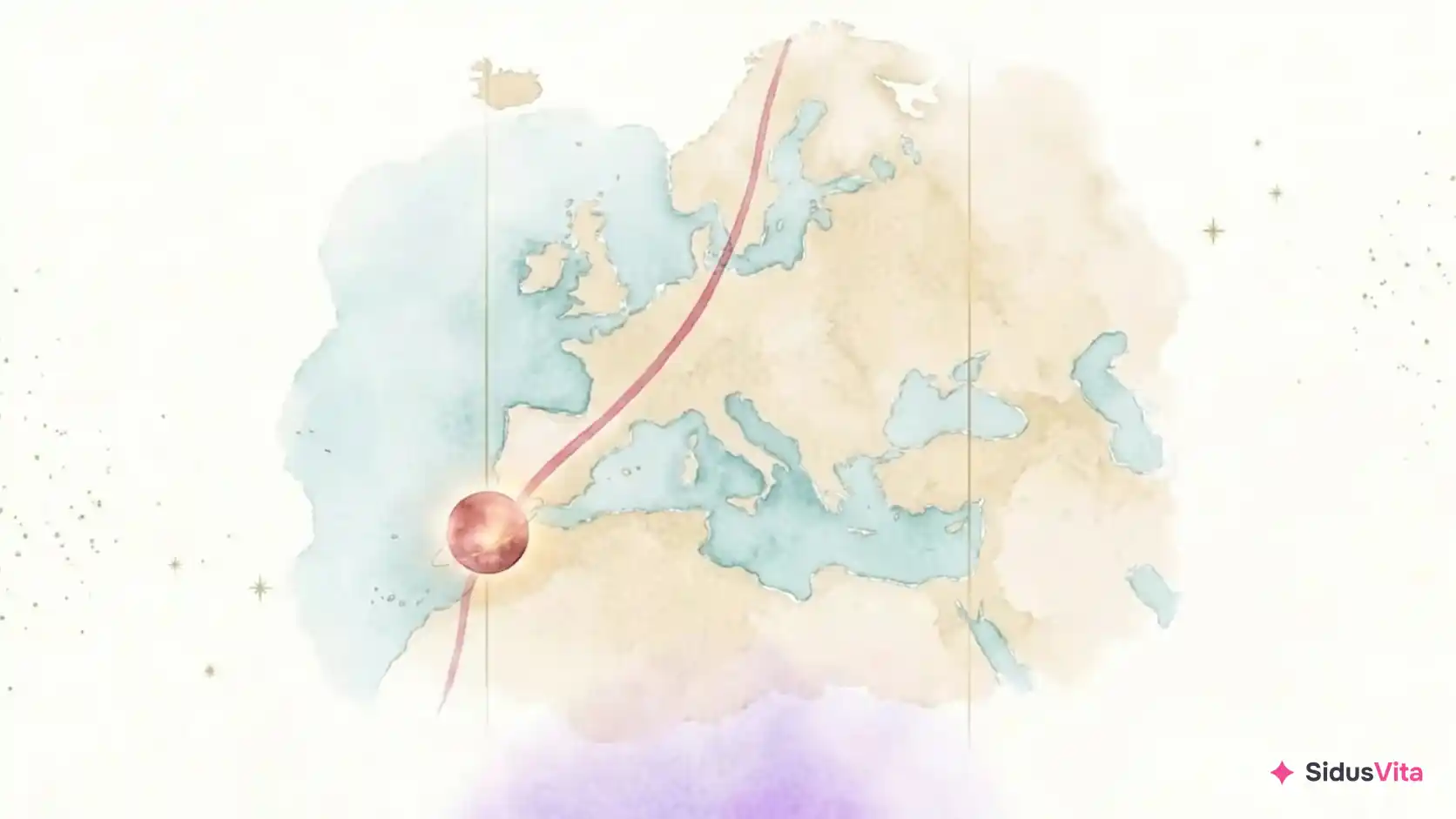
In our Chicago example, the Venus DSC line passes 3 km from Lisbon, yet the free love-city card points to San Jose, California, on a different Venus line. That gap shows how astrocartography for love works. The Venus DSC line, Venus on the Descendant, runs through every place where Venus was setting in the west at the minute you were born, and tradition calls it the line of love. Venus has three more lines: rising (ASC), upper culmination (MC) and lower culmination (IC). The Love tab on our map adds the setting lines of the other nine planets, thirteen lines in all. Within 150 km a city sits in a line's main zone; by 600 km the line fades out. Across 2,000 random charts, a typical Venus DSC line had 21 of our 1,667 cities within 300 km, and the whole Love tab had 359. With a retrograde Venus, check the calculation method too: the two common methods often disagree by hundreds of kilometres.
Thirteen lines on the Love tab
At the moment you were born, every planet was rising somewhere, setting somewhere, crossing the meridian at upper culmination somewhere and at lower culmination somewhere else. That gives each planet four lines on a world map: two verticals for the MC and IC, and two curves for the ASC and DSC. The MC line is often called the zenith line. Our guide to reading astrocartography explains the geometry, the two methods and what a wrong birth time costs. This article stays with Venus and the people-and-love side of the map.
The calculator titles the four Venus lines "the line of love" (DSC), "charm on display" (ASC), "recognised for your taste" (MC) and "a beautiful, peaceful home" (IC). The Venus DSC text has two halves. The promise: "Relationships come to the front, and agreeing with people is simpler." The price: "expecting love to solve everything: it is easier to choose a pleasant person than the right one." Like every line text, this is a reading tradition that the calculator carries on; only your own experience of a place can test it.
The Love tab is wider than Venus. The hint under it reads: "Every planet’s setting line, the one about relationships, plus all four Venus lines." So next to the line of love you will find the Moon DSC ("warm relationships"), Jupiter DSC ("generous partners"), Saturn DSC ("serious commitments"), Mars DSC ("passionate, complicated bonds") and Neptune DSC ("romance and illusion"). Each describes a different kind of closeness, and it pays to read the planet before the word "love".
How many cities sit near a Venus DSC line
A Venus DSC curve stretches across half the globe, so it passes plenty of cities. We drew it for 2,000 random birth moments from 1950 to 2008 and measured the distance to each place in the calculator's own city set: 1,667 places from GeoNames, meaning cities of 300,000 people or more, capitals and 75 popular relocation destinations. In a typical chart, 10 of them lie within 150 km of the line, 21 within 300 km and 45 within 600 km.
The spread is wide. One chart in ten has no more than a single city within 300 km, and another one in ten has 75 or more. In 8.1% of charts no city from our set lies within 300 km.
Popular destinations are scarcer. Of the 75 popular relocation destinations, a Venus DSC line passes within 300 km of two on average, and of none at all in 56.5% of charts. If your shortlist is Lisbon, Mexico City and Bali, the line of love may well miss all three.
Nearby cities become common once all thirteen lines count. The four Venus lines together have a median of 117 distinct cities within 300 km, about 7% of the set. The thirteen Love lines have 359, close to one city in five. A line near a city is therefore common; what tells you something is which planet it is, which angle and how many kilometres away.
Where the free love city comes from
Without an account, the calculator names at most one city, the love city, and opens one line in full, "Your line of love". It picks them like this. Seven lines are candidates, in order of priority: Venus DSC, Venus ASC, Jupiter DSC, Moon DSC, Sun DSC, Venus IC and Venus MC. The calculator keeps up to five cities within 300 km on each. The line that wins is the one with a city closest to your own place, which is your birthplace until you add another. Of those five it takes the most popular city, relocation destinations first and then by population, skipping your own city and anything within 40 km of it; an area without a suitable city is skipped.
We ran the same choice for 1,000 random charts, each with a random birthplace from the set:
| Line that supplied the love city | Its title in the calculator | Share of charts |
|---|---|---|
| Venus MC | "recognised for your taste" | 19.4% |
| Venus IC | "a beautiful, peaceful home" | 17.2% |
| Venus ASC | "charm on display" | 16.4% |
| Venus DSC | "the line of love" | 13.0% |
| Moon DSC | "warm relationships" | 12.3% |
| Sun DSC | "bright people around you" | 10.9% |
| Jupiter DSC | "generous partners" | 10.8% |
The Venus DSC line supplied the love city in only 13% of charts. The median distance from the love city to the birthplace was 2,727 km, and to its own line 155 km, which already puts a typical love city past the 150 km main zone. So read the card before the city name: it always says which line the city came from, and a Venus MC city is about being valued for your taste at work rather than meeting someone.
After a free sign-in you get up to four cities, one per area: love, work, home and self. Pro opens all 40 lines and up to five cities on each. You can also test a shortlist for free, one city at a time: enter a city under "Your city" (the "Change city" button swaps it), and the card names the nearest line within 600 km, if there is one, and its distance.
Venus stays near the Sun, and retrograde Venus strays from the ecliptic
Seen from Earth, Venus never strays more than about 47° from the Sun. In our sample of 20,000 moments from 1950 to 2008 the widest angle between them in the sky was 47.2°, and the median 30.6°. That ties the Venus lines to the Sun lines: the Venus MC vertical never sat more than 51.2° of longitude from the Sun MC, which is 5,690 km at the equator.
Venus is retrograde for roughly 41 days in every 584-day cycle, 7.1% of the moments in our sample. Retrograde motion alone does not move a line, which is drawn from where the planet stands, not from the direction it travels. But retrograde Venus passes between the Sun and the Earth, close to us, and so it can sit far north or south of the ecliptic, the Sun's apparent path. Direct Venus was within 1.4° of the ecliptic in half of our moments; retrograde Venus, within 6.0°. The largest value in the sample was 8.7°.
That distance decides how far the two common methods disagree. One takes Venus where it actually stood in the sky; the other moves it onto the ecliptic and keeps only its zodiac degree. In the calculator they are called "Real sky" and "Zodiac line", under "More settings", in "How to calculate the lines". Here is the gap, in kilometres along the parallel:
| Line and latitude | Direct Venus: half of cases within / 95% within | Retrograde Venus: half of cases within / 95% within | Gap over 300 km: direct / retrograde |
|---|---|---|---|
| Venus DSC at 40° | 94 / 371 km | 321 / 817 km | 9.1% / 54.6% |
| Venus DSC at 50° | 119 / 465 km | 461 / 894 km | 13.3% / 75.3% |
| Venus MC at 50° | 26 / 71 km | 118 / 223 km | 0% / 0% |
The verticals barely move; the setting curve can move a lot. If your Venus is retrograde, look at both versions of the line of love before you settle on a city.
A sample chart: 8 May 1996, 5:50 pm, Chicago
This chart is made up: we picked the date by search so that one map shows several cases at once. Venus stands at 25°59′ Gemini, direct, 37.6° from the Sun in the sky and 4.4° north of the ecliptic, which is a large tilt for a direct Venus. The person behind the example is weighing six cities.
| City | Venus DSC, Real sky | Zodiac line | Birth 15 minutes earlier | 15 minutes later | Other Love lines within 600 km |
|---|---|---|---|---|---|
| Lisbon | 3 km | 329 km | 268 km | 255 km | none |
| Paris | 31 km | 372 km | 232 km | 160 km | none |
| Berlin | 174 km | 610 km | 17 km | 321 km | none |
| Barcelona | 539 km | 915 km | 310 km | 759 km | none |
| Toronto | over 5,000 km | over 5,000 km | over 5,000 km | over 5,000 km | Mars DSC, 368 km |
| Los Angeles | over 5,000 km | over 5,000 km | over 5,000 km | over 5,000 km | Saturn DSC, 222 km; Venus MC, 535 km |
The line of love crosses Europe. By the real sky, Venus DSC passes 3 km from Lisbon and 31 km from Paris, both in the main zone, and 174 km from Berlin, just inside the fading zone. Barcelona, at 539 km, is near the outer edge.
The free view points somewhere else. "Your line of love" in this chart is the Venus MC, because it runs closest to Chicago: down the west coast of North America, 68 km from Vancouver, 108 km from Portland and 144 km from San Francisco. The love city is San Jose, California, 191 km from that line and 2,957 km from Chicago. After sign-in the other areas add San Francisco for work (Venus MC again), Playa del Carmen for home (Moon IC, 56 km) and St Petersburg for self (Jupiter ASC, 156 km). With Pro, the thirteen Love lines show 54 cities, up to five per line. Entering Lisbon under "Your city" shows the Venus DSC 3 km away, free.
The method moves the line to Britain. By the zodiac line, Venus DSC shifts away from Lisbon (329 km) and Paris (372 km) and runs 4 km from Reading and 45 km from London. The 4.4° tilt of this Venus is enough for that.
Lisbon's distance from the line changes with the birth time. Lisbon stays within 150 km only if the true birth time falls between 5:42 and 5:58 pm. Fifteen minutes either way puts it more than 250 km out. Berlin works the other way round: 15 minutes earlier, the line runs 17 km from it. If the time came from memory rather than a document, choose "±15 minutes" in "How exact is the time?" and each line becomes a band.
Reading Lisbon, start with the question that closes the Venus DSC text: "What kind of relationship do I want right now: light, deep, steady?" Then compare it with what the city asks in money, language and work.
What a line of love cannot tell you
Scientific testing of astrology has found no evidence for its premises or purported effects, and astrocartography is part of astrology. A line describes the theme of a place. Whether you meet someone depends on people, work, language and how long you stay. The calculator says it plainly under the map: "Whether to move is your call: visas, work and the people you love matter more than lines."
If a Venus line catches your eye, visit for a few weeks before deciding anything bigger. Look back as well: enter the cities where you have already lived under "Your city", one at a time, and compare the line texts with what you remember, keeping in mind that matches are easy to recall and misses are easy to forget.
You can find your own lines in the astrocartography calculator. It needs your birth date, exact time and city. Without an account you get the Love tab, one line in full, at most one love city and the nearest line within 600 km of your own city; a free sign-in shows up to four cities, one per area; Pro opens every line and up to five cities on each. If you are choosing between several cities, the calculator also leads to "Places map", a paid reading in the Pro pack: it compares two to five cities for the goal "Relationships" and looks for windows in the next 12 months when slow planets cross the angles of each city's chart. For the wider question of how to compare cities with your chart, see our page on the relocation chart.