Charts and practical examples
Yod in a Birth Chart: The Finger of God in Guy Ritchie, Will Smith and Naomi Watts
Guy Ritchie, Will Smith and Naomi Watts were born within 18 days of each other in September 1968, and all three have the same yod in their birth charts, the long, narrow triangle of planets that astrologers call the Finger of God. For 36 days that autumn, Saturn stood at the tip of a yod formed with Neptune and Pluto, so everyone born in those weeks got one. Roughly one person in twelve has a yod, and in an ordinary year one is present about 8% of the time; in 1968, by our hour-by-hour count of the planets from 1900 to 2030, it was there for more than a third of the year. The yod is one of the patterns in "What's rare in your chart," a chapter of our birth chart reading. In Chekhov's letters and in interviews with Meryl Streep, Gary Oldman, Ritchie and Watts, we found moments when they kept coming back to one task, and the sources are listed at the end.
What a yod is and how common it is
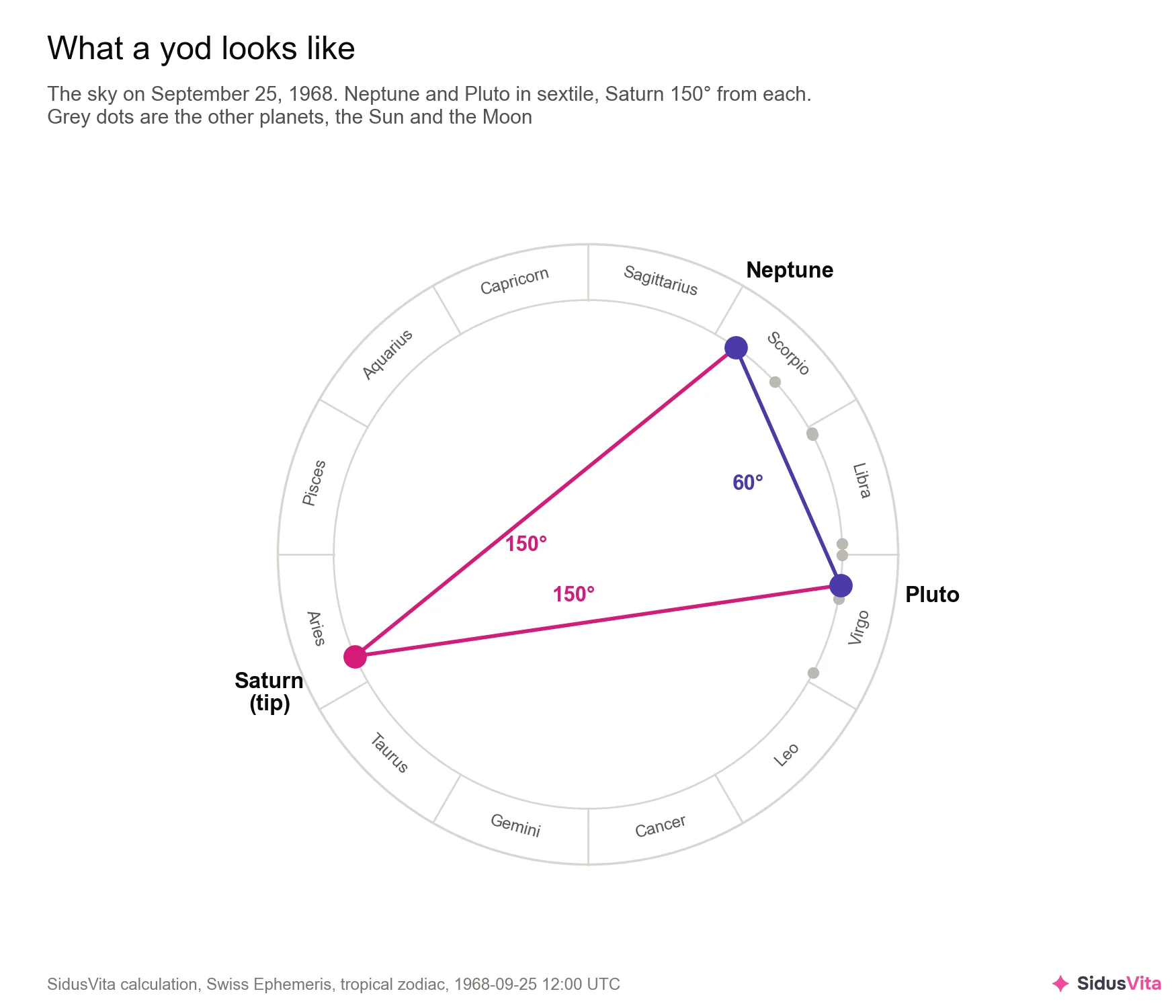
Astrologers call a 60° angle between two planets a sextile and a 150° angle a quincunx. A yod forms when two planets in sextile are both in quincunx to a third one, called the apex. Drawn on the chart wheel, the three lines make a long, thin triangle that seems to point at the apex, which is where the nickname comes from. The name itself is the tenth letter of the Hebrew alphabet, and the astrologer Karen Hamaker-Zondag devoted a whole book to the pattern, The Yod Book (2000).
How exact the angles must be is a matter of choice. We count a sextile within 3° of 60° and quincunxes within 2.5° of 150°, using the Sun, the Moon and the eight planets out to Pluto. With these limits, the frequency table behind our chapter, built from 100,000 charts of people born between 1960 and 2008, finds a yod in 8.4% of them. Saturn is the most frequent apex (20.7% of charts with a yod), followed by the Moon (14.6%).
A yod that includes the Moon does not last: the Moon moves about 13° a day, so the triangle forms and dissolves within hours, and such yods account for almost a third of all the time a yod is in the sky. Yods made of planets alone last longer, though half of those between 1900 and 2030 came apart in less than 3.2 days, and only six out of 765 held for more than a month. When a yod holds for the whole day, a birth time isn't needed to know it is there, and that is the kind we checked for everyone in this article.
The yod years
For a yod to last for weeks, slow planets have to be in it. From 1945 to 1993, and again since 2020, Neptune and Pluto have spent most of their time about 60° apart, and whenever Saturn or Jupiter passes 150° from both, everyone born in those weeks has a yod. That is what happened in 1968, when a yod was present for 35.6% of all the hours in the year, and in 1973 (26.4%). The leanest years in the whole period were 2018 and 1918, with a yod less than 2% of the time.
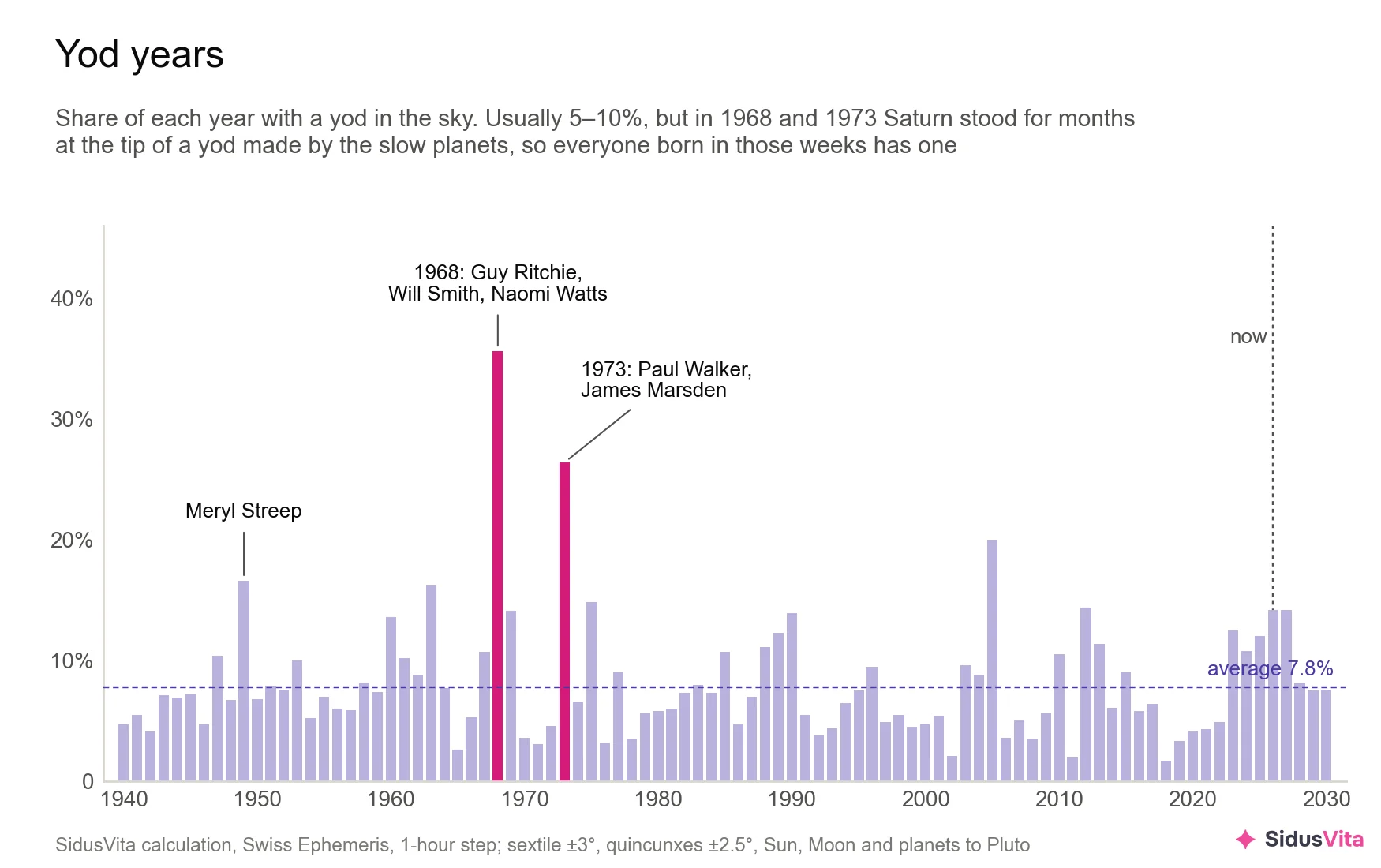
In 1968 Saturn was in Aries. From June 7 to August 4 it was the apex of a yod with Uranus and Neptune, and from September 5 to October 11 the apex of one with Neptune in Scorpio and Pluto in Virgo. Born in those 36 days were Guy Ritchie (September 10), Marc Anthony (September 16), Will Smith (September 25), Jim Caviezel (September 26), Naomi Watts (September 28) and Thom Yorke (October 7). Our celebrity database has nine people with birthdays inside that window, and all nine have the yod.
Five years later came the record. From August 23 to November 13, 1973, Saturn spent 82 days at the apex of a yod with Jupiter and Neptune, the longest such figure between 1900 and 2030. Sixteen people in the database were born in those weeks, among them Dave Chappelle, Paul Walker, Andrew Lincoln, James Marsden, Yorgos Lanthimos, Lena Headey, Neve Campbell, Seth MacFarlane and Aishwarya Rai, and again every one of them has a yod.
What astrologers read into it
Astrologers tend to describe the yod as the mark of a special task, with the strength of two harmonious planets converging on one point and leaving the person with a sense that something is expected of them. Our chapter calls the trait just that, "A sense of a special task," and its text says that one part of life keeps asking for adjustment, that you change your approach to it again and again, and that the same situation keeps coming back in different forms until you find a new answer. It adds that easy paths bore people with a yod quickly, and that the adjustment works best as a craft, correcting the course a little each time.
Those are the stories we went looking for: someone makes a piece of work, sees that the answer isn't in it yet, and comes back to it from another side.
Doing it over
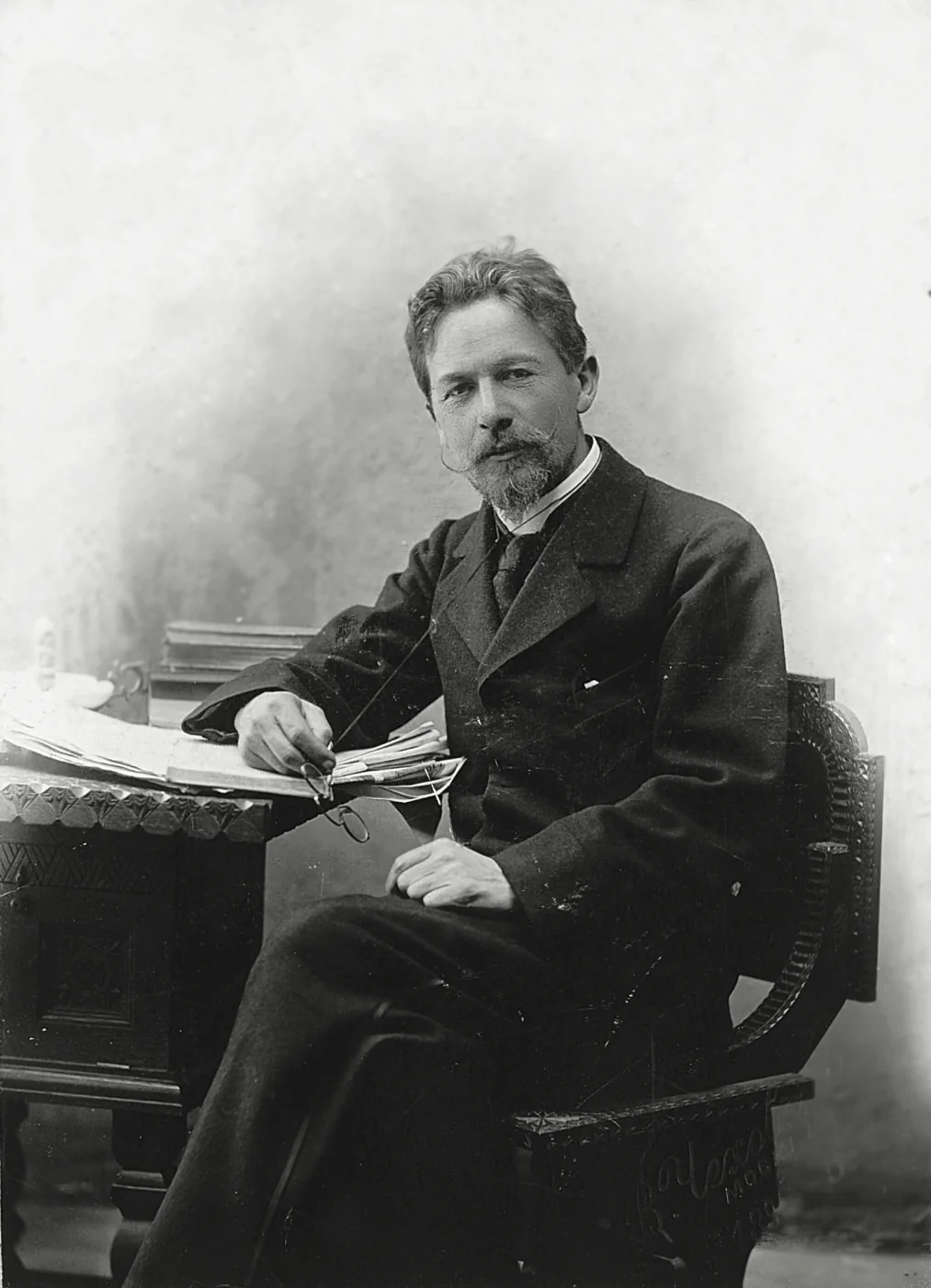
Chekhov wrote Ivanov in the autumn of 1887 for Korsh's theater in Moscow, and told his brother Alexander that it was his first try at a play and had happened almost by accident: "I wrote the play by chance, after a conversation with Korsh. I went to bed, thought up a subject and wrote it. It took two weeks, or rather ten days." The play was staged, and a year later, in October 1888, he reread it and wrote to his publisher Alexei Suvorin that with a new fourth act, a few cuts and a monologue "that is already sitting in my head," it would come out finished and very effective, and that he would fix it by Christmas and send it to the Alexandrinsky Theater in St. Petersburg. A few days later he reported: "In Ivanov I have radically reworked acts two and four. I gave Ivanov a monologue, retouched Sasha, and so on. If they don't understand my Ivanov even now, I'll throw it in the stove." In December he went back to the play once more, and on December 28 he asked Suvorin to stop changing it for the sake of a single role and print it as it had stood a week earlier: "Otherwise you'll never finish correcting it. The road of corrections is a dangerous road." The quotations are our translations from the Russian. Chekhov's yod has Mercury and Neptune at the base and Saturn at the apex.
Guy Ritchie reworks scenes on set. Talking to Collider in 2023 about Operation Fortune, he said he hadn't liked the script to begin with, and "We just rewrote every scene on the day in this film almost completely." The general ideas worked as fixed points: "You'd hold onto those as base camps for your summit. But how you got to those base camps was completely spontaneous on the day." In 2025, around the release of Fountain of Youth, he told Sharp magazine that he treats the script as a map: "What we will do is try to improve the map on the day and it keeps it alive." He also allowed for the other outcome: "If you can't beat what's on the page, then we will just go with what's on the page but it's fun for everyone to collaborate and try to see if you can improve the map that you've got. 9 times out of 10, you can."
Shaquille O'Neal, who performs as DJ Diesel, badly wanted a slot at the Tomorrowland festival in 2015. His manager, whom he had met at another festival, laughed at first and said he didn't book celebrity DJs, and O'Neal told Winter Music Conference that he "was able to change his mind after about the fifth mix I sent him once I refined my skills." Louis de Funès described his own temperament this way in 1971: "I don't have a good character, because I look for perfection in everything and in other people. So I will always be dissatisfied" (our translation from the French).
Finding another way in
Preparing for Sophie's Choice in 1981, Meryl Streep planned to study Polish five days a week for three months and told Time: "I don't know how I see the character yet. I'm still in the 'intuit' stage, and I haven't picked her apart yet. First I'll learn Polish. Then I'll forget me. Then I'll get to her. That's my plan of action." Thirty years later, working on Margaret Thatcher in The Iron Lady, she mastered Thatcher's way of speaking, as the Los Angeles Times reported, by recording voice memos on her iPhone modeled on a six-minute interview Thatcher gave in 1987. Streep's chart has two yods, both with Jupiter at the apex.
Gary Oldman saw the BBC's Tinker, Tailor, Soldier, Spy with Alec Guinness when it aired in 1979, and when he was cast as George Smiley in 2011 he made a point of not watching it again: "I really thought that I would be contaminated by it," he told NPR's Fresh Air. "And I didn't want to do an impersonation." Instead, he told NPR, he tried on dozens and dozens of pairs of glasses, searching for just the right look.
Naomi Watts said in 2025 that by the time she met David Lynch, who cast her in Mulholland Drive, "it was 10 years into flunking auditions," and that she was "literally alienating people" with how much she needed a job. By then she had a rule, which she described to W magazine in 2017: "I didn't believe in traveling or breaking plans for auditions because I had done that many times before at my own expense and things had gone badly." When Lynch's office called, she was in New York. "But this was David Lynch and it's not every day that you get that call," she said, so she flew to Los Angeles and went to the meeting straight from the airport.
The people in this article
| Who | Known for | Born | Yod: base → apex |
|---|---|---|---|
| Anton Chekhov | writer, playwright | January 29, 1860 | Mercury and Neptune → Saturn |
| Louis de Funès | actor | July 31, 1914 | Mercury and Venus → Jupiter |
| Meryl Streep | actor | June 22, 1949 | Sun and Saturn → Jupiter, Saturn and Uranus → Jupiter |
| Gary Oldman | actor | March 21, 1958 | Jupiter and Pluto → Sun |
| Guy Ritchie | director | September 10, 1968 | Neptune and Pluto → Saturn |
| Will Smith | actor | September 25, 1968 | Neptune and Pluto → Saturn |
| Naomi Watts | actor | September 28, 1968 | Neptune and Pluto → Saturn |
| Shaquille O'Neal | basketball player, DJ | March 6, 1972 | Sun and Mars → Uranus |
For all eight the yod holds through the whole day of birth, so no birth times were needed for this table.
Where the method stops
We chose these episodes already knowing who has a yod, and almost anyone with a long career has something they reworked many times as well as something they got right on the first try. Ivanov itself was written in ten days, and it was Chekhov who warned Suvorin a year later that the road of corrections is dangerous. Ritchie, who rewrites scenes as he goes, says himself that when the set can't beat the page, they shoot what's written.
Dates matter even more. When slow planets form a yod, everyone born in those weeks gets it, and the nine people in our database born in September and October 1968 share it with no connection to fame or character. Across the whole database, 223 of 3,443 celebrities have a yod, or 6.5%, fewer than in our chapter's table, because for people with no known birth time we only count yods that last the whole day, and the short yods involving the Moon drop out. Other astrologers also allow wider angles, so they find yods more often, and readings of the yod as a task or a destiny remain an interpretation that only makes sense alongside the rest of the chart.
How to find a yod in your own chart
Calculate your birth chart and open "What's rare in your chart." If you have a yod, you will see which planets form the base, which one sits at the apex, and which celebrities share the pattern. If the Moon is part of your yod, you need an exact birth time; a yod made of planets alone usually only needs the date. The next yod without the Moon forms on October 16, 2026, and lasts until October 21, with Uranus and Neptune at the base and Venus at the apex. The next long one comes in August 2027, when from August 13 to 31 Jupiter will stand at the apex of a yod with Neptune and Pluto.
This is the fifth piece in our series on rare traits of famous people, after Mars and Saturn in the same degree, Venus retrograde, Mercury square Jupiter and Ronaldo's and Messi's retrograde planets.