Charts and practical examples
Grand Trine and Kite in a Birth Chart: Kurt Cobain, Tom Cruise and Stephen Hawking
Laura Dern, Benicio del Toro and Kurt Cobain were born within ten days of each other in February 1967. All three share one grand trine, Jupiter, Saturn and Neptune standing 120° apart in water signs, and Uranus opposite Saturn turns their triangle into what astrologers call a kite. A grand trine is any three planets that form an equilateral triangle on the chart wheel. In "What's rare in your chart," a chapter of our birth chart reading, it turns up in about one chart in thirteen, and the kite in about one in twenty. By our hour-by-hour count of the planets from 1900 to 2040, a grand trine is present about 9% of the time in an ordinary year, it was there 41% of the time in 1937, and the 1980s were its leanest decade. In Stephen Hawking's memoir and in interviews with Tom Cruise, Cobain and Stan Lee, we found stories about what comes at once and where that ease goes.
What a grand trine and a kite are
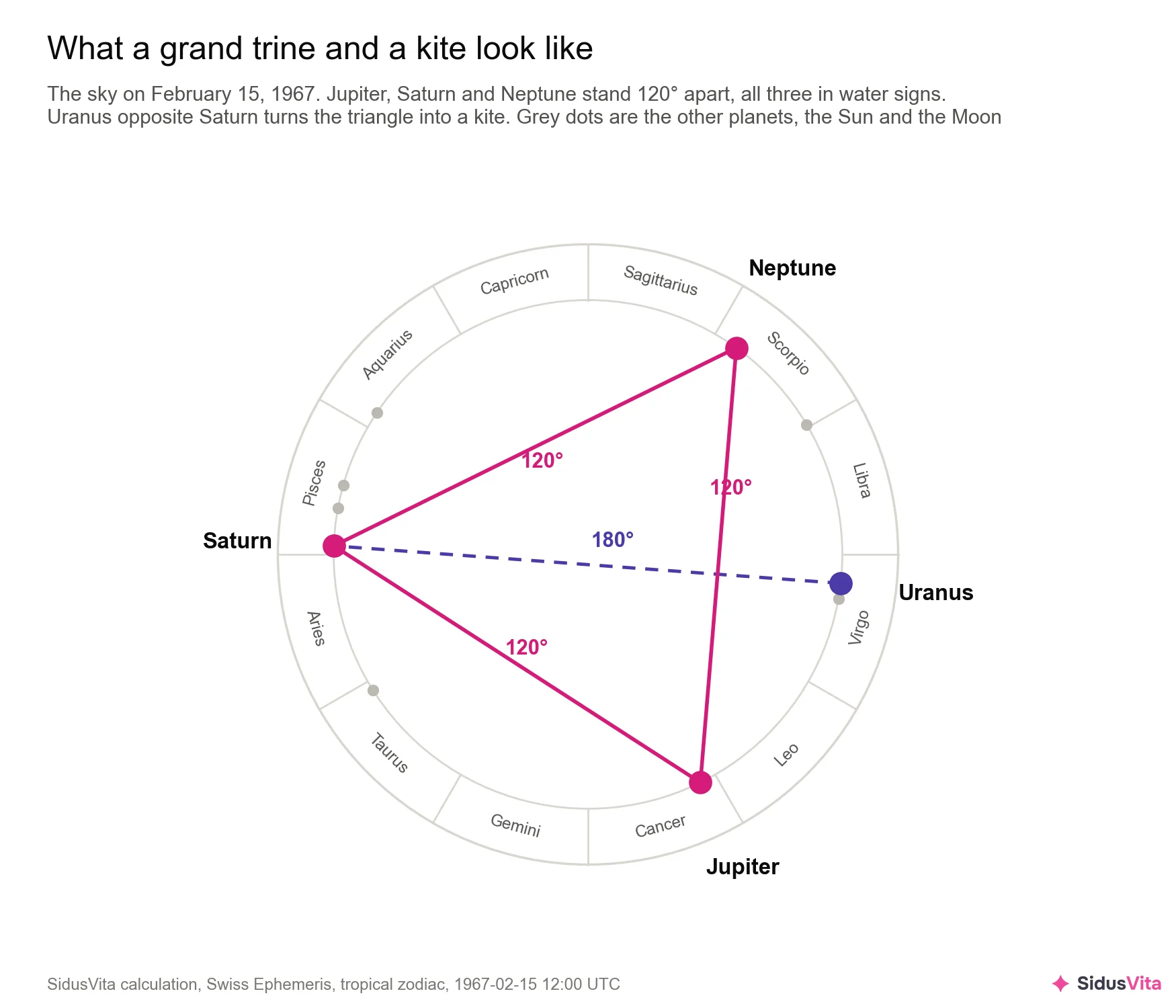
Astrologers call a 120° angle a trine and read it as the most harmonious of the aspects: planets in trine usually sit in signs of the same element, fire, earth, air or water, and are said to support each other without effort. A grand trine forms when three planets are each in trine to the other two, and lines drawn between them make an equilateral triangle on the chart. Every astrologer sets their own allowance for how exact the angle must be. We count a trine when it is within 6° of 120°, and we include the Sun, the Moon and the eight planets out to Pluto. With these rules, the frequency table behind our chapter, built from 100,000 charts of people born between 1960 and 2008, finds a grand trine in 7.55% of charts, and an exact one, within 3°, in only 2.15%.
A kite forms when a fourth planet stands opposite one corner of the triangle, 180° away. The line of that opposition runs through the center of the wheel, and the figure starts to look like a kite with a tail. The kite turns up in 5.13% of charts in our table, which means that two grand trines out of three, 67.9%, are kites as well.
A trine that includes the Moon does not last. The Moon moves about 13° a day, so such a triangle forms and dissolves within hours. Trines held together only by the Moon account for more than a third of all the time a grand trine is in the sky. A triangle of planets alone lasts longer, usually around a week: we counted 381 such windows between 1900 and 2040, and only ten lasted more than a month. When a trine holds for the whole day, the birth time doesn't matter, and those are the trines we checked for everyone in this article.
Grand trine years
For a grand trine to last for weeks, slow planets have to be in it, Jupiter, Saturn, Uranus, Neptune or Pluto, and then everyone born in those weeks has it. Over the 131 years from 1900 to 2030, a grand trine was present 9.4% of the time on average, but the record year of 1937 reached 41.4%, partly because Jupiter, Uranus and Neptune held a triangle in earth signs for almost seven weeks that year. In the 1920s a grand trine was in the sky a fifth of the time, in the 1980s only 3.4%, and in 1984 there was not a single hour of a grand trine without the Moon.
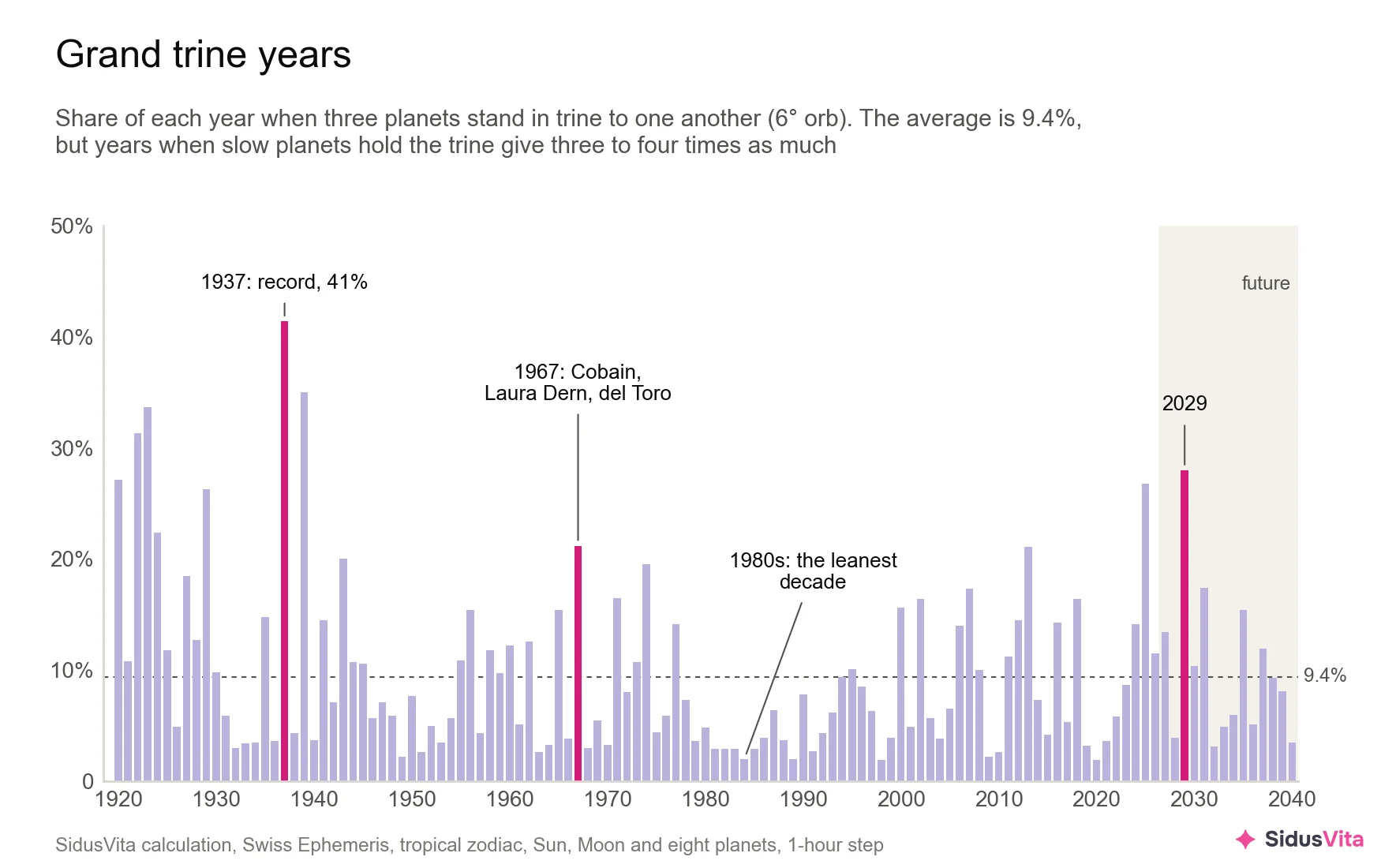
In early 1967 Jupiter was in Cancer, Saturn in Pisces and Neptune in Scorpio, and from January 16 to March 6, 49 days in a row, the three held a triangle in water signs while Uranus in Virgo stood opposite Saturn. Laura Dern and Vince Gilligan, the creator of Breaking Bad, were born in those weeks (both on February 10), followed by Benicio del Toro (February 19) and Kurt Cobain (February 20). Seven people in our celebrity database were born inside that window, all seven have the grand trine, and five have the kite.
From December 20 to 28, 1971, Venus, Saturn and Pluto formed a triangle in air signs, and in those nine days Ricky Martin, Jared Leto and Savannah Guthrie were born, each with that trine and the kite that goes with it. Christian Bale and Olivia Colman were born on the same day, January 30, 1974, and have the same air trine of Mercury, Saturn and Uranus. Stephen Hawking and Muhammad Ali were born nine days apart in January 1942 with different trines that rest on the same pair: Uranus and Neptune were in trine in earth signs, and the third corner was Mercury for Hawking and the Sun for Ali.
What astrologers say about the grand trine
A trine is usually read as ease and natural talent, and popular astrology often calls the grand trine a good-luck triangle. That luck has a well-known downside, and Rae Orion's "Astrology For Dummies" puts it plainly: the grand trine, "a symbol of the slacker, is notorious for bringing just enough good fortune to keep you from feeling that you have to exert yourself."
In our chapter the grand trine is called "Much comes easily." Its description says that where others need a month of study, a few evenings are enough, and that when a task suddenly gets hard, the person drops it faster than others, even though they could go further than anyone. The kite is called "Ease with a direction": whatever comes without effort, the person gathers into one goal, drifts and spends themselves on small things without one, and is hard to stop once a goal appears.
It came right away
In his memoir "My Brief History," Stephen Hawking recalled that the prevailing attitude among Oxford undergraduates in his day was anti-work, and admitted: "I once calculated that I did about 1,000 hours' work in the three years I was there, about an hour a day." When Newsweek drew five lessons on becoming a genius from the book in 2013, this one came first.
Stanley Kubrick's father, a serious amateur photographer who kept a darkroom at home, gave him a Graflex camera. One day the teenager simply walked into the offices of Look magazine with a portfolio of finished work. Look published his first photograph in 1945: a newsstand vendor surrounded by papers announcing the death of President Roosevelt.
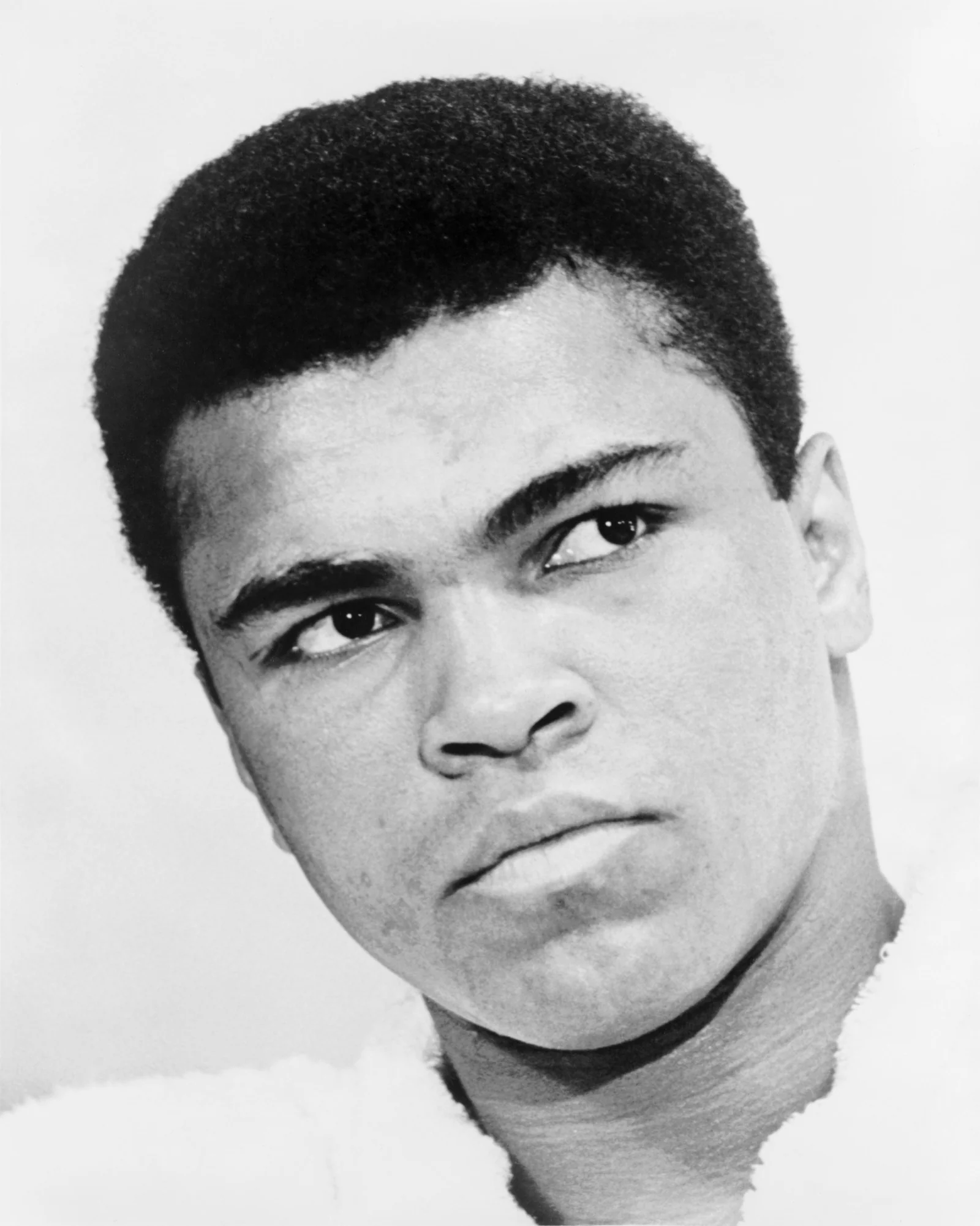
In 1954 Muhammad Ali, then Cassius Clay, rode his bike to an event at the Louisville Service Club, and when he was ready to leave, the bike was gone. He was sent down to the basement Columbia Gym, where he met Joe Martin, an off-duty police officer who ran the city's boxing program, and told him he meant to beat up whoever had taken it. Martin, as the Kentucky Historical Society tells it, suggested he first learn to fight properly. Charlie Hunnam was spotted while shopping for shoes with his brother by Andy Snelgrove, the production manager of the teen drama Byker Grove, and that became his first role. Later, when agents weren't much interested in him, he badgered them until they sent him to an audition, and he recalled: "I ended up getting the first job that they sent me out on." That job, at 18, was Queer as Folk.
Ease with a direction
Tom Cruise told People in 2022 that as far back as 1985, on the first Top Gun, he wanted to make "a love letter to aviation," and that Maverick came from the same place: "It's about flying. Not only the challenges, but the beauty." For the younger cast, Cruise, as Variety reported, worked with aerial coordinator Kevin LaRosa Jr. to put together an intense flight program that started in a small plane: "We started with the Cessna 172 and we took them through basic flying." Cruise's chart has a kite of the Sun, Jupiter and Neptune in water signs, with Pluto opposite Jupiter.
Kurt Cobain told Rolling Stone's David Fricke in 1994 how "Smells Like Teen Spirit" came about: "I was trying to write the ultimate pop song. I was basically trying to rip off the Pixies. I have to admit it." By 1960 Stan Lee had spent twenty years in comics and was ready to quit, and his wife Joan, he said, answered: "Why not write it the way you want to write it? If it doesn't work, the worst that's going to happen is that they'll fire you. And you want to quit anyway." The result, in 1961, was the Fantastic Four.
On August 28, 1963, Martin Luther King Jr. was delivering his prepared speech at the Lincoln Memorial when the singer Mahalia Jackson said out loud from behind the podium: "Tell them about the dream, Martin." As History notes, the films of the speech show King leaving his notes behind at that moment to improvise, and that part became the "I Have a Dream" speech. King's chart has a kite of Jupiter, Saturn and Neptune, with Mars opposite Saturn.
People in this article
| Who | Known for | Born | Grand trine | Kite |
|---|---|---|---|---|
| Stan Lee | comics writer | December 28, 1922 | Mars, Jupiter, Pluto (water) | yes |
| Stanley Kubrick | film director | July 26, 1928 | Venus, Saturn, Uranus (fire) | no |
| Martin Luther King Jr. | minister, civil rights leader | January 15, 1929 | Jupiter, Saturn, Neptune | yes |
| Stephen Hawking | physicist | January 8, 1942 | Mercury, Uranus, Neptune (earth) | no |
| Muhammad Ali | boxer | January 17, 1942 | Sun, Uranus, Neptune (earth) | no |
| Tom Cruise | actor, producer | July 3, 1962 | Sun, Jupiter, Neptune (water) | yes |
| Laura Dern | actress | February 10, 1967 | Jupiter, Saturn, Neptune (water) | yes |
| Benicio del Toro | actor | February 19, 1967 | Jupiter, Saturn, Neptune (water) | yes |
| Kurt Cobain | musician | February 20, 1967 | Jupiter, Saturn, Neptune (water) | yes |
| Jared Leto | actor, musician | December 26, 1971 | Venus, Saturn, Pluto (air) | yes |
| Christian Bale | actor | January 30, 1974 | Mercury, Saturn, Uranus (air) | no |
| Charlie Hunnam | actor | April 10, 1980 | Sun, Mars, Neptune (fire) | yes |
For all twelve, the pattern holds for the whole birthday, so no birth time was needed for the table. King's three corners fall in signs of different elements: with a 6° allowance that happens when a planet sits at the very edge of a sign.
Where the method ends
We chose these episodes already knowing who has a grand trine, and almost anyone with a long career has both something that came at once and something they had to fight for. Hunnam himself had to badger his agents before landing that first job, and the flight program for the cast of Maverick looks nothing like a thing that comes by itself.
Then there are the dates. When slow planets form the triangle, everyone born in those weeks gets it, and the seven people in our database born between mid-January and early March 1967 got it together, with no connection to fame or temperament. Across the database, 227 of 3,443 celebrities have a grand trine, or 6.6%, and 128 have a kite, or 3.7%. That is lower than in our chapter's table, because for people without a known birth time we only count patterns that hold all day, so short trines with the Moon drop out. Finally, other astrologers use their own allowances for the angles, so they find trines more or less often, and readings of the grand trine as a gift or as laziness remain an interpretation that only makes sense alongside the rest of the chart.
How to find a grand trine in your chart
Calculate your birth chart and open "What's rare in your chart." If you have a grand trine or a kite, you will see which planets form it and which celebrities share the pattern. If the Moon is part of the triangle, you need an exact birth time; for a trine of planets alone, the date is usually enough.
From April 2026 to August 2028, Uranus and Pluto stay in trine to each other almost without a break, and whenever a third planet reaches the first degrees of Libra, a grand trine forms in air signs. The nearest such windows without the Moon come from July 19 to August 4, 2027, with Mars, and in September 2027 Mercury, Venus and the Sun each step in for a few days. The longest grand trine window without the Moon in all of 1900–2040 is due in 2029, when Mars stays in trine to Uranus and Pluto from January 2 to March 25, 82 days in a row.
This is the seventh piece in our series on rare traits of famous people, after Mars and Saturn in the same degree, Venus retrograde, Mercury square Jupiter, Ronaldo's and Messi's retrograde planets, the yod, or Finger of God and Kaal Sarp yoga.